
Are You Already in the Change Trap?

Every executive hears the same two sentences: “We need to accelerate change” and “We need to reduce our costs.” Then they launch a transformation program to do both at once. Eighteen months later, projects are slower, the IT budget is bigger and nobody can explain why.
I call this the change trap. Before I describe it, let’s check whether you are already in it. Seven questions. Yes or no. No consultants required.
The Quiz
Answer honestly. Not what the roadmap says, what actually happened.
- Does a typical project touch more than five systems before it goes live?
- Did your IT spend rise over the last three years while delivery got slower?
- Has anything — a system, a platform, an integration — actually been decommissioned this year?
- Can you name the owner of your customer data without calling a meeting?
- Do you have more than three ways of integrating systems running in production today?
- Is there a “temporary” exception older than two years still alive in your landscape?
- Is your current transformation program bigger, in budget and scope, than the one before it?
Scoring key. Give yourself one point for every “yes” on questions 1, 2, 5, 6 and 7, and one point for every “no” on questions 3 and 4.
- 0 to 2 points: you are not trapped. Yet. Keep removing things.
- 3 to 4 points: you are at the edge. Complexity is growing faster than your ability to absorb it, and the next big program will decide which way you fall.
- 5 to 7 points: you are in the trap. And here is the uncomfortable part: your transformation program is probably not the cure. It is the cause.
Most companies score five or more. They are rarely surprised by the individual answers. They are surprised by the total.
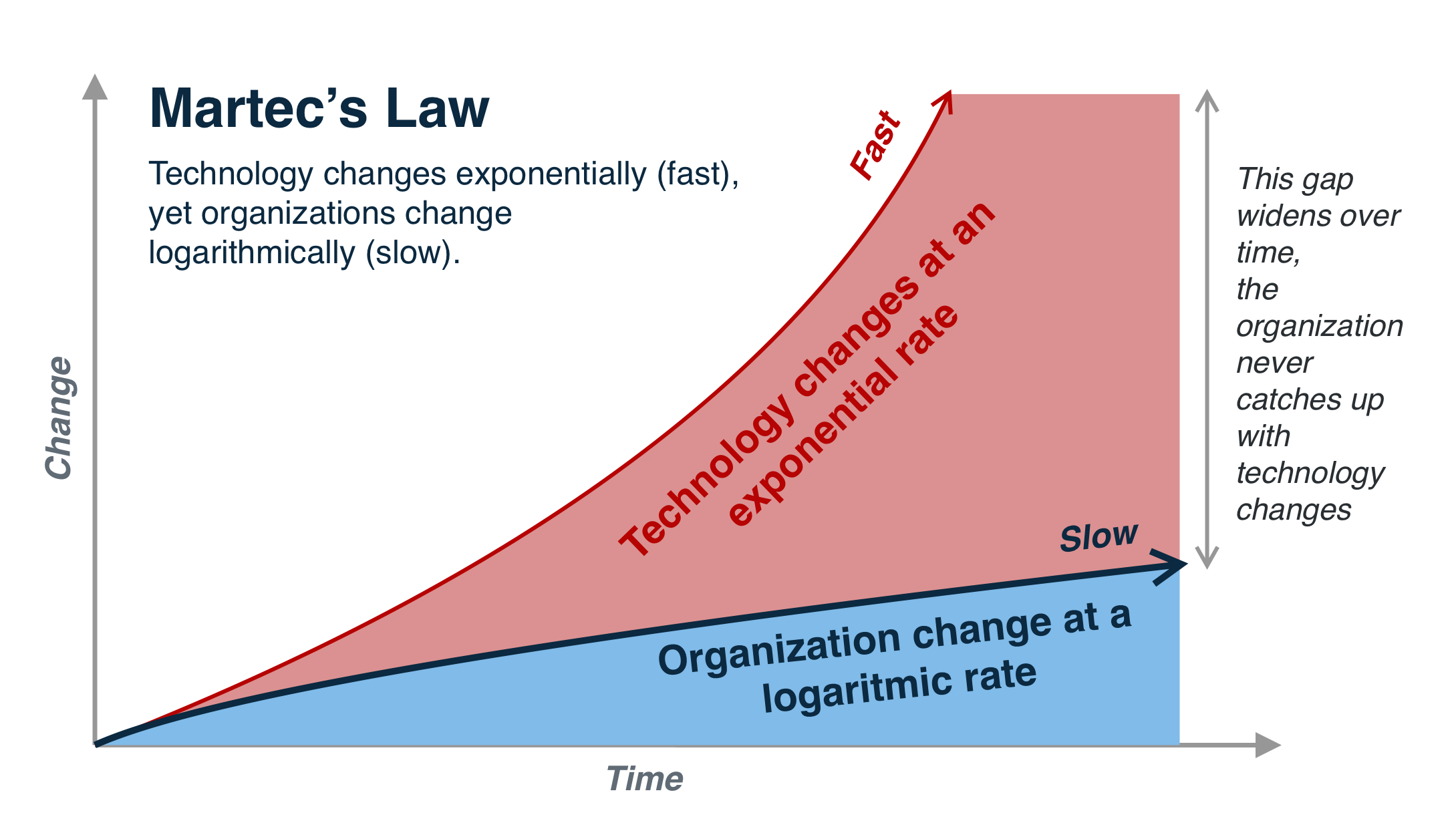 Technology keeps accelerating while organizations change slowly, and the gap between the two grows.
Diagram from the book
What the Trap Is
The trap is structural, not technical. It is not a lack of technology, investment or ambition.
Every project adds something: a system, an integration, a platform, an exception. Very little is ever removed. Over time the landscape becomes a dense web of dependencies where every change touches multiple systems and every innovation increases the cost of the next one.
Behind it sits Martec’s Law: technology changes exponentially, organizations change logarithmically. People must learn, processes must adapt, governance must catch up, culture must move. That is not a leadership failure, it is a human limit. The gap between what is technically possible and what your organization can absorb only widens.
Companies respond to that gap with more initiatives. More initiatives create more systems. More systems create more complexity. More complexity reduces the capacity to change. Reduced capacity creates more pressure to transform. That is the cycle. The more you try to transform, the harder transformation becomes.
Nobody decides to walk into it. That is what makes it a trap. Let me show you how it happens.
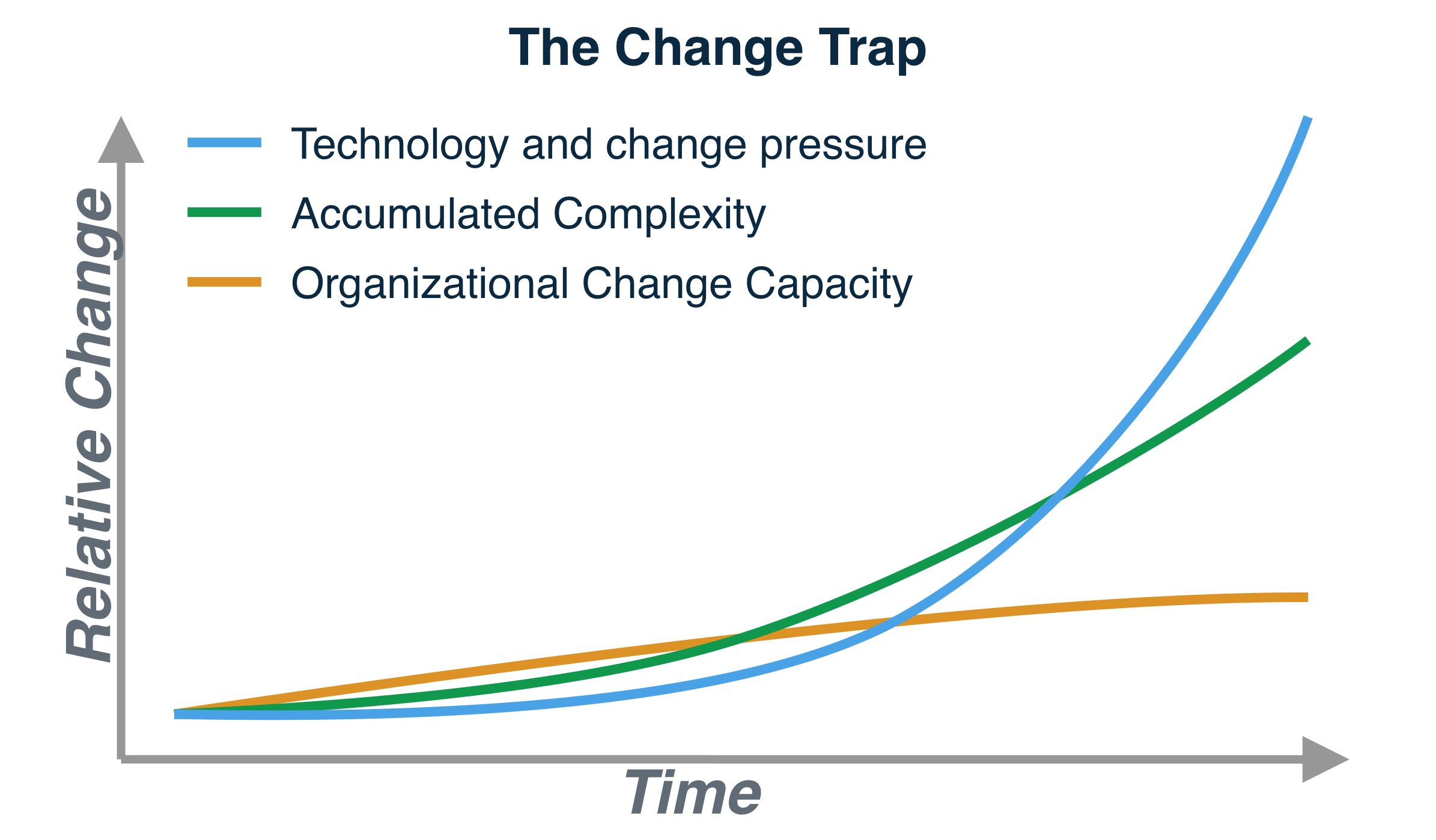 Pressure and complexity keep climbing. The capacity to absorb change does not.
Diagram from the book
Twelve Rational Decisions
Picture a mid-size company. Call it Nordvik, a distributor with a few hundred million in revenue, an IT team of sixty and a board that reads the same articles yours does. Nordvik is fictional. The decisions are not.
Year one, Q1. The old CRM cannot do marketing automation. Nordvik buys a cloud CRM. Rational: the business case is solid and the vendor is a market leader.
Q2. The integration platform team has a four-month backlog. The CRM project connects directly to the ERP with point-to-point links. Rational: waiting would have killed the launch date.
Q3. The board wants sustainability reporting in place before the next annual report. Nobody checks whether that date is required by anyone outside the building; it is simply set. Nordvik buys a reporting tool and copies customer and order data into it. Rational: the deadline is fixed, and arguing with the board costs more than a tool.
Q4. Nordvik acquires a smaller competitor with its own ERP. Both ERPs stay “until the integration program”. Rational: migrating during an acquisition is reckless.
Year two, Q1. Marketing wants a customer portal in three months. An agency builds it on a stack nobody inside knows. Rational: speed to market, and the agency came recommended.
Q2. Sales keeps its pricing logic in a spreadsheet that feeds the CRM through a nightly job. An exception is granted “for six months”. Rational: the alternative was rebuilding pricing during peak season.
Q3. The board asks for an AI strategy. A data lake is built, with a third copy of customer data. Rational: you cannot do AI without data.
Q4. The old CRM is not switched off. Two warranty reports and one partner interface still depend on it. Rational: keeping it costs less than rebuilding those three things.
Year three, Q1. An API gateway is introduced to “clean up integrations”. The old point-to-point links stay, because migrating them is nobody’s project. Rational: new integrations will be better from now on.
Q2. To regain control, an architecture review board is created. Every change now gets a review. Rational: somebody has to look at the whole.
Q3. The CIO launches “One Platform”, a three-year transformation program with a budget larger than any previous one. Rational: the landscape is clearly a mess and the board wants a bold answer.
Q4. A product manager asks for one small thing: add a loyalty tier to the customer record and show it in the portal. Two weeks of work, she estimates.
It takes nine months.
Why Two Weeks Became Nine Months
Nobody at Nordvik can explain it in one sentence. Everybody can explain their part.
The customer record exists in four places: the new CRM, the old CRM, the reporting tool and the data lake. Each has a different owner, or no owner. Three integration styles carry the field: point-to-point links, the nightly spreadsheet job and the new gateway. The portal runs on a stack only the agency understands, and the agency has moved on to its next client. The review board asks for an impact analysis, which takes six weeks because nobody has a current picture of the landscape. Then the One Platform program announces a change freeze on the CRM, because it will be replaced anyway. Then the second ERP turns out to also store a loyalty flag.
Twelve decisions, each defensible in its own meeting. Each made locally, under pressure, without anyone asking what it would cost the next change. The loyalty tier did not hit one problem. It hit all twelve at once.
This is the mechanic of the trap: every change raises the cost of future change, a little, invisibly, until one ordinary request exposes the total.
The Wrong Way Out
Here is the part that matters most, and the part most companies get wrong.
The change trap is not a prison. You can get out. But look at what Nordvik did when it felt stuck: a gateway on top of the integrations, a board on top of the decisions, a program on top of the landscape. Every escape attempt added a layer. None removed one.
That is the reflex everywhere. When change gets hard, launch a bigger transformation. New platform, new framework, new governance, new budget. It feels decisive. It is also exactly the move the cycle is waiting for: more initiatives, more systems, more complexity, less capacity. The program that was meant to break the trap tightens it. Three years later there is a new CIO, a new program and the same landscape, plus one more platform that was never fully migrated.
Add enough of these cycles and the organization crosses a line. It has not failed to change. It has lost the ability to change. Projects stall, costs rise, teams spend their time managing complexity instead of creating value. At that point the only exit left is a disruptive, organization-wide reset, which is what every CIO was trying to avoid in the first place.
The Right Way Out
The way out is not another program. It is a different discipline, and it starts with subtraction.
When Steve Jobs returned to Apple in 1997, he did not write a better strategy document. He cut the product line to four and said no to almost everything else. Apple did not recover by adding. It recovered by removing noise.
Translate that to Nordvik. Decommission the old CRM, even if it means rebuilding three reports. Decide who owns customer data and make the other copies consumers, deliberately. Allow two integration patterns, not three, and migrate the rest. Make the pricing exception visible, rare and expensive, with an end date somebody defends. Document the decisions and the rejected alternatives, not the hundredth landscape diagram, so the next product manager does not need six weeks to learn what everyone used to know.
None of that is a platform purchase. All of it increases change capacity. And that is the real job: not adopting technology faster, but staying able to change repeatedly without breaking and without exploding your costs. Organizations that manage this treat every decision as intentional instead of reactive, limit their technology choices relentlessly, improve their metabolism with short feedback loops and decentralized execution inside clear guardrails, and reset deliberately and rarely instead of accidentally and often.
The trap is real. The exit is real too. It just does not look like the thing your board wants to announce.
Take the Score Seriously
Go back to your quiz result. If you scored five or more, your next transformation program is the most dangerous decision on your agenda, because it will feel like progress while it closes the gap on you.
Before launching it, ask the only question that matters: will this reduce the cost of the next change, or increase it?
I wrote Screw Architecture Manage Change for leaders who want to answer that honestly. It describes the trap in detail, why the usual architecture theater does not get you out, and how discipline and reuse turn change into a capability instead of a cost.
- Get the ebook: https://wellofwisdom.community/b/samcebook
- Get the paperback: https://wellofwisdom.community/b/samcpaperback
- Everything else: http://wellofwisdom.community
Run the quiz with your leadership team this week. Then count the things you switched off this year. If the answer is zero, you already know where to start.
Screw Architecture Manage Change — the CEO playbook, 40 diagrams and the deck. Ebook €24.50, paperback €44.50.
Get the bookOne mail with the chapter, then an occasional note like this one — and €5 off the book when you decide.