
My Son, My Book, and the Micromanagement Trap

My book has artwork now. A cover, and an illustration for every chapter. My son, Milo Van de Putte, created all of it.
I’m proud of that. Not just because the drawings are good — they are — but because of what it took to get there. Because I almost killed the whole collaboration before it started.
And the way I almost killed it is the exact same way managers kill digital transformations every day.
Let me tell you the story.
How I Nearly Broke It
When I asked Milo to illustrate “Screw Architecture Manage Change,” I had it all figured out. I knew my book. I knew my chapters. So naturally, I knew what every drawing should look like.
For the cover, I gave him instructions. For chapter one, I gave him instructions. The figure should be here. The symbolism should be this. The style should feel like that.
The result? Nothing flowed.
He wasn’t motivated to work on it. Deadlines slipped. Every drawing session felt like pulling teeth. I was the frustrated father who wanted to publish his book. He was the frustrated son who didn’t want to work on something that wasn’t his.
My approach was wrong — and I didn’t see it.
I was treating an artist like a pair of hands. I had hired expertise and then refused to let the expertise do its job.
 Creative Artwork
Photo by aju.bee on Pexels
Creative Artwork
Photo by aju.bee on Pexels
The Turning Point
At some point I stopped and reversed course. I gave Milo complete artistic freedom. Style, metaphors, technique, composition — all his. He is the artist. I had to trust him.
But — and this matters — I didn’t give him complete freedom on everything. One thing stayed fixed: the content. Each piece of artwork had to express the message of its chapter. The Change Trap. The Architecture Illusion. The weight of organizational debt. That was the boundary. That was non-negotiable.
Everything inside that boundary was his.
And then something remarkable happened: the artwork started flowing. Faster delivery. But not just faster — better. More consistent. More creative. Drawings I could never have specified, because they came from his imagination, not my instructions. A figure straining against a massive boulder. A person caught between two closing platforms. A leader standing inside a question mark.
I gave him one clear constraint and full freedom within it. That’s when the collaboration became a collaboration. And yes — it helped us bond, which is worth more than any book.
 What it feels like to be managed into a corner, instead of given room to work.
Copyright Milo Van de Putte
What it feels like to be managed into a corner, instead of given room to work.
Copyright Milo Van de Putte
I See This Everywhere
Here’s the uncomfortable part. I made a mistake that I have watched managers make for my entire career.
Managers micromanaging their own experts. People managers — whose job is to shape the performance of the team — diving into technical details, second-guessing implementation choices, disturbing the product delivery flow of people who know the work better than they do.
It doesn’t just frustrate the experts. It slows delivery down. And it makes the output worse, because the expert ends up executing the manager’s mediocre idea instead of their own excellent one.
I knew all of this. I’ve said all of this. And I still did it to my own son. That’s how seductive control is when you care about the outcome.
 One of the chapter illustrations Milo Van de Putte created for the book.
Copyright Milo Van de Putte
One of the chapter illustrations Milo Van de Putte created for the book.
Copyright Milo Van de Putte
The Contrarian Part
Now, before you conclude the lesson is “just give teams full autonomy” — stop. That’s the other way transformations die, and it’s the quieter one.
Giving teams “complete freedom” with no fixed direction is how digital transformations quietly bleed out. Every project chooses its own tools. Platforms multiply. Functionality gets duplicated. Custom creeps into what should be common. Investment horizons shift without anyone deciding they should. The strategic direction drifts, one reasonable-looking local decision at a time.
That drift has a price, and in the book I call it what it is: slower change, technological complexity, and a tech debt tax that every future project pays.
Milo’s artwork taught me the formula, and it’s the inverse of what most organizations do:
Freedom of style and execution. Discipline on direction.
Most organizations run it backwards. They micromanage execution — reviews, approvals, managers in the technical weeds — while letting the strategic direction drift. The experts are suffocated exactly where they should be free, and the landscape is free exactly where it should be constrained.
If I had done that with Milo, I would have dictated his brush strokes while letting him draw whatever topic he liked. Imagine the result: a frustrated artist producing beautiful drawings that have nothing to do with the book.
That is, more or less, the state of many transformation programs.
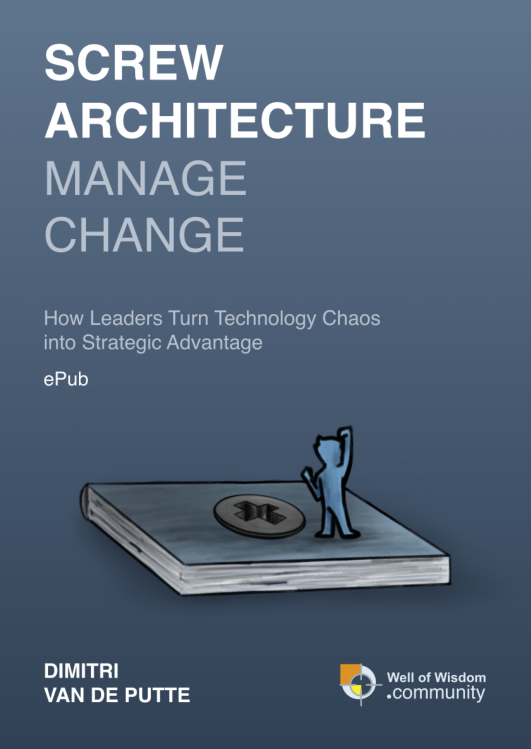
 The cover illustration for “Screw Architecture Manage Change,” drawn by Milo Van de Putte.
Copyright Milo Van de Putte
The cover illustration for “Screw Architecture Manage Change,” drawn by Milo Van de Putte.
Copyright Milo Van de Putte
Guardrails, Not Instructions
So where exactly should a leader’s control end and an expert’s freedom begin?
The artwork gave me a practical answer. Three steps.
Step 1: Decide the boundaries upstream
Before the work starts — not during, not after — decide what is fixed and what is free. For the artwork: the content of each chapter was fixed; everything else was free. For a technology landscape: which capabilities are core and demand strict reuse, which are dynamic, which are innovative and open for experimentation. What’s common and should follow the market. What’s unique and justifies being different. And for how long you’re committing — the investment horizon. A core platform you’ll live with for a decade deserves different constraints than an experiment designed to be replaced.
These are upstream decisions. Once a project is funded and running, the real decision has already been made. Reviewing it afterwards is theater.
Step 2: Document the decision once
Write the boundary down. Once. Not a framework, not a forty-page reference architecture — the decision. What’s fixed, what’s free, why, what alternatives were rejected, and when it should be revisited.
With Milo, this was a single conversation: “Here’s what each chapter says. The drawing has to carry that message. The rest is yours.” He never had to guess where the line was, and I never had to re-negotiate it per drawing. That’s what decision documentation does: it replaces continuous interference with a stable, visible agreement.
Step 3: Get out of the way
This is the step most leaders fail — I certainly did. Once the boundary is set and documented, your job is to stop. No hovering. No “small suggestions” about execution. No sliding back into the details because you’re anxious about the outcome.
If the work stays within the guardrails, the expert’s judgment wins. If the guardrail itself turns out to be wrong, change the guardrail — deliberately, documented, once — not the expert’s execution.
 The cover illustration for “Screw Architecture Manage Change,” drawn by Milo Van de Putte.
Copyright Milo Van de Putte
The cover illustration for “Screw Architecture Manage Change,” drawn by Milo Van de Putte.
Copyright Milo Van de Putte
What You Get Back
When I finally got out of Milo’s way, I got back everything I’d been trying to force: speed, consistency, creativity — and a son who was proud of the work instead of resenting it.
Organizations get the same return. Teams that move fast because they’re not waiting for permission on things that were never the manager’s business. A landscape that stays coherent because direction was fixed where it mattered. Experts who bring you their best idea instead of your average one.
Freedom of execution. Discipline on direction. Guardrails, not instructions.
It took a teenager with a sketchbook to make me live the lesson I wrote a whole book about.
 The cover of “Screw Architecture Manage Change,” illustrated by Milo Van de Putte.
Copyright Milo Van de Putte
The cover of “Screw Architecture Manage Change,” illustrated by Milo Van de Putte.
Copyright Milo Van de Putte
See It for Yourself
Every chapter of “Screw Architecture Manage Change” now opens with one of Milo’s illustrations — each one his interpretation, within one clear constraint. If you want to see where guardrails beat instructions, in art and in architecture:
- Get the ebook: https://wellofwisdom.community/b/samcebook
- Get the paperback: https://wellofwisdom.community/b/samcpaperback
And if you recognized yourself in the first half of this story — the instructing, frustrated version of me — maybe start with step 3: get out of the way.
Screw Architecture Manage Change — the CEO playbook, 40 diagrams and the deck. Ebook €24.50, paperback €44.50.
Get the bookOne mail with the chapter, then an occasional note like this one — and €5 off the book when you decide.