
The Whiteboard That Saved Apple — and the Trap Your Company Is Still In

(Photo by Gulom Nazarov on Unsplash)
When Steve Jobs walked back into Apple in 1997, the company was roughly 90 days from insolvency. The product catalog was a mess: dozens of overlapping Macintosh models, printers, cameras, the Newton. Engineers couldn't explain the difference between a Performa 6400 and a Power Mac 6500. Neither could customers.
Everybody expected a visionary strategy. A bold new roadmap. More innovation, faster.
Jobs did the opposite.
He walked up to a whiteboard and drew a simple grid. Two columns: Consumer and Pro. Two rows: Desktop and Portable. Four quadrants. Four products.
Everything that didn't fit in a quadrant got killed. Around 70% of the product line — gone. Not because those products were bad. Because they were noise.
Apple didn't escape death by changing faster. It escaped by making change possible again.
How it was seen inside Apple: not genius — heresy
Here's the part of the story people forget, and it's the part that matters most.
At the time, this move was not celebrated as visionary. Inside Apple, it was seen as brutal. The widely documented accounts of that period — you can read them on Wikipedia's pages about Jobs' return and the products he cancelled — describe an executive who killed projects that teams had poured years into. The Newton, Apple's pioneering handheld, was discontinued in 1998 despite a passionate internal and external fanbase. The clone-licensing program, which other executives had fought to build, was shut down. Entire product lines like the Performa series disappeared.
Thousands of jobs went with them.
Engineers who had bet their careers on those products were furious. Some of the cancelled projects were genuinely good technology. The Newton's handwriting recognition was ahead of its time — its DNA later resurfaced in the iPhone era. Killing it looked, to many insiders, like destroying the future to save the present.
Outside Apple, the press was largely writing obituaries. Michael Dell famously said that year that if he ran Apple, he'd "shut it down and give the money back to the shareholders."
So let's be honest about what the four-quadrant moment actually felt like: not clarity, but loss. Not strategy, but sacrilege. The signal only became visible in hindsight. In the moment, it looked like noise-killing looked like value-killing.
That's exactly why almost no organization does it.
The trap Apple was in — and you probably are too
Every executive hears the same two sentences today:
"We need to accelerate change."
"We need to reduce our costs."
The board wants innovation. Investors want efficiency. Customers want better digital services. Competitors are moving faster every year. And at the same time, the economic reality is tightening: inflation drives up operational costs, markets get more volatile, margins shrink.
So organizations are asked to do something extremely difficult: change faster while spending less.
Digital transformation promises exactly that. And according to McKinsey research, around 70% of transformation efforts fail to achieve their objectives.
Most leaders assume the problem is technology.
They are wrong. Their problem is unmanaged change.
Here's how it works. Over time, every project adds systems, integrations, and platforms. Very little is ever removed. Exceptions become permanent. Applications multiply. Complexity grows faster than the organization's ability to manage it.
The result is familiar: every new initiative takes longer, costs more, and delivers less than expected.
I call this the Change Trap. And it feeds on itself. The harder change becomes, the more you compensate with extra projects, extra tooling, extra coordination layers — which adds more complexity, which makes change even harder. A cycle, not a phase.
Apple in 1997 wasn't short on ideas or talent. It was drowning in accumulated decisions nobody had ever revisited. Sound familiar?
"But we are not Apple" — the excuse that keeps you trapped
I hear this objection every single time I tell the Jobs story. Let me deal with it head-on.
"We're not Apple. We don't have a Steve Jobs. We can't just kill 70% of our landscape — we have regulators, legacy contracts, customers depending on those systems."
All true. And all beside the point.
Nobody is asking you to be Apple. The lesson of 1997 is not "hire a genius and let him swing the axe." The lesson is structural, and it applies to a mid-sized insurer in Antwerp just as much as to a consumer-tech icon in Cupertino:
First, Apple's problem was not a lack of vision — it was an excess of accumulated, unrevisited decisions. That is exactly your problem too. You don't need Jobs' taste to fix it. You need his willingness to revisit decisions everyone else treats as permanent.
Second, the objection assumes the choice is between "kill 70%" and "do nothing." It isn't. You won't cut 70%, and you don't have to. What you must do is what Apple did structurally: make explicit choices, limit options, and stop letting the landscape grow by default. That works at any scale, in any industry, with or without a charismatic founder.
Third — and this is the uncomfortable one — "we are not Apple" usually means "we don't want to feel what Apple felt." Remember: inside Apple, the cull felt like loss and heresy. If deleting things in your organization would trigger the same outrage, that's not evidence you're different. That's evidence you're in exactly the same trap. The pain of removal is the symptom, not a counterargument.
You are not Apple. Fine. But the Change Trap doesn't care about your industry, your size, or your founder story. It only cares whether you keep accumulating or start deciding.
The most expensive lie: "We just need to become more agile"
When companies notice the trap, the standard answer is an agile transformation. SAFe rollouts. Tribes and squads. Maturity assessments. Coaches everywhere.

Here's the uncomfortable truth, and it has a name: Martec's Law. Technology changes exponentially. Organizations change logarithmically, at best. The gap between the two doesn't shrink — it widens, every single year.
Which means: no organization can outrun technology change. Not with more sprints. Not with a higher maturity score. Not with agility theater.
You will never be fully caught up. That is the new normal.
The winners don't try to move faster than the curve. They choose adaptability over maturity models. They accept permanent change — and then they choose their battles:
- Which capabilities actually differentiate us?
- Which technology domains deserve continuous investment?
- Where do we deliberately accept stability instead of novelty?
Discipline starts by focusing energy where it compounds, not where it merely reacts.
And the second lever is just as unglamorous: relentlessly limit technology choice. Unconstrained choice is the fastest path to complexity. Be strict about technologies, platforms, programming languages, integration patterns, tooling ecosystems. Every option you allow is a future integration you'll maintain, a skill set you'll need to staff, an exception that will quietly become permanent.
Jobs understood this instinctively. Four quadrants wasn't a product strategy. It was a constraint strategy.
Five signals you're already in the Change Trap
Most organizations don't notice they're trapped, because the trap tightens slowly. Here's a quick self-diagnosis. Be honest.
- Projects take longer every year. Not because ambitions grew — because the same type of project that took six months in 2019 now takes fourteen. Nobody can quite explain why.
- Budgets rise while output shrinks. IT spend goes up annually, yet the business feels it gets less. The money isn't going to new value. It's going to keeping the existing complexity alive.
- Every change touches five systems. A "simple" request — change a field, add a product variant, update a pricing rule — triggers a chain reaction across systems, integrations, and teams. Impact analysis takes longer than the change itself.
- Your best people manage complexity instead of creating value. Your most experienced engineers and architects spend their days on coordination, workarounds, and firefighting. Ask them how much of their week goes to building something new. Then brace yourself.
- Nobody dares to remove anything. Systems live forever because nobody knows what depends on them. Decommissioning is always "next year." The landscape only grows.
Three or more? You're in the trap. And here's the hard part: you cannot sprint your way out of it. Adding change pressure to a trapped organization just makes the walls thicker.
What a four-quadrant moment looks like for your IT portfolio

You probably can't reduce your application landscape to four boxes. But you can run the same exercise Jobs ran — not on products, but on your portfolio of systems and change initiatives.
Put everything on the wall and ask the Jobs questions:
- Does this differentiate us, or is it commodity? Differentiating capabilities deserve continuous investment. Commodity capabilities deserve standardization and stability — not novelty.
- What would we kill if we had to cut 70%? You won't cut 70%. But the exercise reveals, brutally fast, what's noise and what's signal.
- What did we add last year — and what did we remove? If the second list is empty, you're not transforming. You're accumulating.
And expect the Apple reaction: people will call the exercise brutal, unfair, impossible. Good. That resistance is the sound of the trap being touched for the first time.
The organizations that escape the Change Trap don't do it with a bigger transformation program. They do it by treating change itself as the thing to be managed: fewer choices, explicit decisions, ruthless focus on where energy compounds.
Apple didn't out-innovate its way back to life in 1997. First, it deleted its way back to the ability to innovate at all. And at the time, almost nobody inside the building thanked Jobs for it.
That's the real job. Not producing more change. Making change possible.
This is the opening argument of my book Screw Architecture, Manage Change — launching in about 12 days.
Chapter 1 goes deep on the Change Trap, Martec's Law, and how organizations get stuck. Want a head start? Sign up now and get the first chapter free today, plus €5 off at launch: wellofwisdom.community.
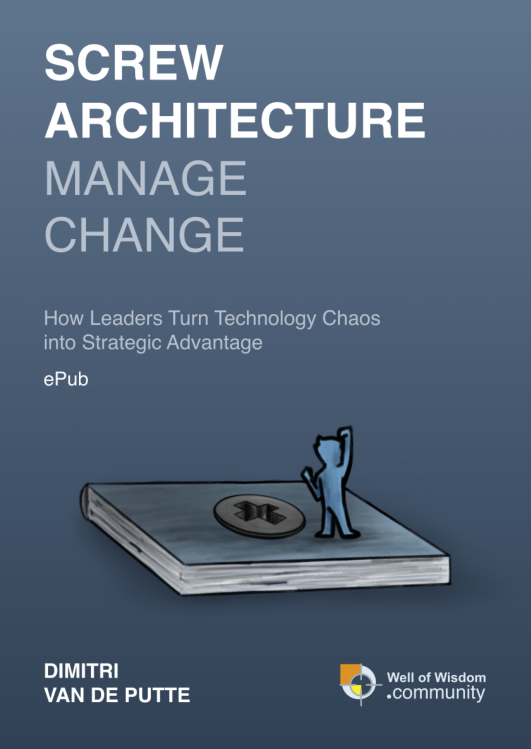
Screw Architecture Manage Change — the CEO playbook, 40 diagrams and the deck. Ebook €24.50, paperback €44.50.
Get the bookOne mail with the chapter, then an occasional note like this one — and €5 off the book when you decide.