
Your Architects Are Too Good, And That Is The Problem

Picture a company I will call Northbank. Insurance, four thousand people, roughly six hundred applications. Northbank employs twenty-two architects: enterprise, domain, solution, data, integration, security. They have a framework, a repository, a principles catalogue with forty-seven entries, a reference architecture per domain, and an architecture board that meets for three hours every month.
By every yardstick the industry uses, Northbank’s architecture practice is mature. In the five years it has existed, it has not changed a single funding decision.
Northbank is a composite. I have changed the name because I keep meeting this company under different ones. It is what the book calls the architecture illusion: the practice looks professional and structured, and the organization’s ability to change does not improve.
Twelve Towers, One Skyline
Here is how Northbank organizes architecture. Each domain architect owns a tower: a slice of the landscape, a model, a roadmap, a set of standards. The towers are well built. Each is internally consistent. Each has a complete view of its world.
What the towers do not have is traffic. Delivery teams run two-week sprints. The architecture board runs a monthly cycle. The funding committee runs a quarterly one. By the time a solution design reaches the board, the project that commissioned it has already selected its vendor, its integration approach and its go-live date. Architecture comments on what has already been decided, logs a few risks, and files the document in the repository.
Twenty-two capable people, working hard, producing excellent artifacts that describe a landscape they do not steer.
 The deviation is logged, the design is approved, and the debt is born.
Photo by Dwayne joe on Unsplash
Too Good At The Wrong Thing
Now the contrarian part. Northbank’s architecture practice is too good.
Not the people. I would hire most of them tomorrow. The practice. It is too good at the discipline as it is taught, and it sits in the wrong place to use that skill. The more rigorous, complete and framework-compliant a practice becomes, the further it drifts from the rhythm of delivery and from the forums where money is actually committed. Rigor takes time. Completeness takes more time. Framework compliance takes time and produces documents that nobody outside the tower can read.
Delivery does not wait. The funding committee does not read.
So the practice measures its maturity in the only currency it controls: artifacts. Applications in the repository. Percentage of projects with a reviewed design. Principles published. Capability map coverage. Those numbers go up every year.
The numbers the business cares about do not move. Time to deliver a change. Cost per change. Number of platforms doing the same job. If anything they move the wrong way.
Maturity measured in artifacts is maturity in the wrong currency. The organization pays the difference in a currency it understands perfectly: budget. And the architects, the ones best placed to notice, are the ones kept furthest from the room where it is spent.
 Three rooms where money moves, and the map on the wall that never entered any of them.
Photo by Ula Kuźma on Unsplash
One Uncomfortable Question
If you lead an architecture practice, or fund one, I have a single question for you.
When was the last time an architecture document stopped a project from starting?
Not slowed it down. Not added a review step. Stopped it. Because the capability already existed. Because the proposed platform duplicated one you already pay for. Because the integration pattern would couple a stable core system to something that will be replaced in eighteen months.
If the honest answer is never, your architecture is describing complexity instead of reducing it. And every tower you add is another layer of cost that the business will quietly route around. Not out of malice. Out of delivery pressure.
At Northbank the honest answer was never. Twenty-two architects, five years, zero stopped projects. Plenty of comments on projects that were already running.
Approved Under Pressure
What the board did produce in volume was approvals. The claims platform design arrives with a go-live date the business has already been promised. It couples the new platform point-to-point to the policy administration system, because the integration team had no time for the event interface the standard prescribes. The board notes the deviation, logs a risk, and approves. What else can it do? Saying no now costs the go-live, and nobody wants to be the architect who missed the quarter.
This is how technical debt enters a landscape like Northbank’s. Not through sloppy engineering. Through executions approved under delivery pressure, one reasonable exception at a time. Each one is rational in isolation. Each one is permanent, because nobody budgets the clean-up and nobody owns the expiry. The point-to-point interface stays. The second integration platform, approved as a temporary measure three years ago, stays. The customer data copied into the new system to save a month stays, and now there are two versions of the truth.
Five years of that and Northbank is pushing a boulder. Every new project has to work around the debt the previous ones left behind, so it takes longer, so it comes under more pressure, so it asks for more exceptions. Complexity compounds, change capacity drops, and the board that logged every risk so thoroughly has become one of the engines of the change trap. The approval stamp looks like governance. It is a debt instrument.
Five Myths From The Tower
Ivory-tower architecture survives on a handful of beliefs. Each sounds reasonable. Each dies under the same question: which decision did this artifact change?
We need the full picture first. The complete landscape diagram, every application, every interface. By the time it is finished, it is out of date. A complete landscape diagram is not architecture. It is an obituary: an accurate record of what was alive at the moment of writing. Which decision did it change? Usually none, because it arrived after the decisions.
Principles change behaviour. Northbank has forty-seven. Reuse before buy before build. Loose coupling. Data has one owner. Every project agrees with all forty-seven and violates whichever ones get in the way. A principle without a decision moment where it is applied is a poster. Which decision did principle twenty-three change last quarter?
Reviews prevent bad decisions. Reviews happen after the decision. A review can document a bad decision beautifully, attach a risk to it, and approve it under pressure. It rarely reverses a vendor contract signed six weeks earlier. Which decision did the last review change? Be specific.
The repository is the source of truth. The repository is the source of whatever someone typed into the repository. The source of truth is the running landscape, and the running landscape is changed by teams who never open the tool. Which decision was taken because someone consulted it?
Business will come to us. They will not. Business goes to whoever can say yes or no before the budget cycle closes. Position architecture as advisory, outside the funding forum, and the business routes around it without noticing it is doing so.
Run these five across your own backlog of artifacts. Most towers will not survive the audit. That is the point.
Where Money Actually Moves
Real architectural impact happens where strategic and investment decisions are taken: portfolio priorities, technology choices, funding, exception approvals. In practice that reduces to three decision moments.
Before funding. Does this capability already exist? Can we reuse instead of rebuild? Does this strengthen or fragment the landscape? What future cost are we creating? Once funding is approved, the decision stops being strategic and becomes implementation. Everything architecture says after that point is commentary.
At technology choice. The moment a team picks a platform, a language, an integration pattern. This is where diversity enters the landscape, and every additional option is cost, risk and cognitive load forever. One clear guardrail here beats fifty principles in a catalogue.
At exception approval. Every landscape needs exceptions. The question is whether they are visible, rare and expensive, or invisible, common and free. Free is what Northbank had: an exception under pressure cost the project nothing and the landscape everything. If nobody owns the exception decision and nobody prices it, every project grants itself one and books the debt against the future.
Architecture present at these three moments changes decisions. Architecture absent from them documents the consequences.
Architectural Impact In Four Moves
You do not need a transformation program to fix this. You need four moves and some nerve. This is how I would change the architectural impact at Northbank.
Move one: find the three rooms. Map the real funding process, the real technology selection path, the real exception route. Not the documented versions. Who sits in the room, when, and what they sign. Then put an architect in each of those rooms with a mandate to say no. If there is no room for exceptions, create one. Northbank had none, which is why every project granted its own.
Move two: cut documentation to size. Each decision gets exactly the documentation it needs. A funding decision needs one page answering the questions above. A technology choice needs the guardrail and the alternatives that were rejected. An exception needs the reason, the debt consciously accepted, who pays it back, and the date it will be revisited. That is the base of the Change Pyramid: decision documentation. Everything else goes on a list, and the list is reviewed with one question. Which decision did this change? No answer, no more maintenance. Not deleted. Just no longer fed.
Move three: sort the landscape by pace layer. Core, dynamic, innovative. This is where most towers get their attention exactly backwards. Northbank’s best architects spent their days polishing the core: the policy administration system, the general ledger, the data warehouse. Stable, commodity, mature vendors: reuse is simply mandatory and the architecture question is mostly closed. Meanwhile the innovation teams, the ones building the AI claims assistant and the partner API, were completely unguided. They picked integration patterns on a Friday afternoon and wired experiments straight into the policy system. Flip it. Core gets strict guardrails and little attention. Innovation gets light rules, an architect in the room, and a hard boundary so experiments never leak into systems of record.
Move four: measure in the right currency. Stop reporting repository coverage. Report four numbers instead: projects stopped or redirected before funding, platforms retired, exceptions granted with their expiry dates, and exceptions actually closed. That last one is your debt curve. If all four read zero after a quarter, you have not left the tower. You have redecorated it.
What Northbank Found
The uncomfortable discoveries came fast. Three projects in the pipeline were each building customer consent management. One already ran in production. Two integration platforms operated side by side because the second had been a pressure exception nobody remembered granting and nobody had ever been asked to retire. The forty-seven principles collapsed into nine guardrails, each tied to one of the three moments.
Twenty-two architects did not become eight. They stopped keeping towers and started sitting where money moved, saying no occasionally, pricing the exceptions they did approve, and writing down why. Same people. Different room.
Nothing about this is clever. It is subtraction. When Steve Jobs returned to Apple he did not commission better documentation. He reduced the product line to four and said no to almost everything else. Architecture only starts adding value when it does the same: fewer artifacts, clearer decision moments, less noise.
The Illusion Ends With Decisions
The architecture illusion is comfortable. The towers look like competence. The repository looks like control. The board looks like governance. Everybody is busy, everything gets approved, and the debt grows.
Real architecture is uncomfortable. It sits in the funding forum and says no, that capability exists. It sits at technology choice and says not that pattern, this one. It owns exceptions and makes them expensive. It documents decisions instead of systems. And it measures itself by what it changed, not by what it produced.
If you recognize Northbank, “Screw Architecture Manage Change” was written for you. It lays out the Change Pyramid, strategic alignment, standards and guardrails, decision documentation, and the discipline-and-reuse engine that turns architecture from a describing function into a change capability.
Get the ebook at https://wellofwisdom.community/b/samcebook or the paperback at https://wellofwisdom.community/b/samcpaperback, and find more on the book’s site at http://wellofwisdom.community.
Then go ask your architects the question. When did a document last stop a project? Watch the room.
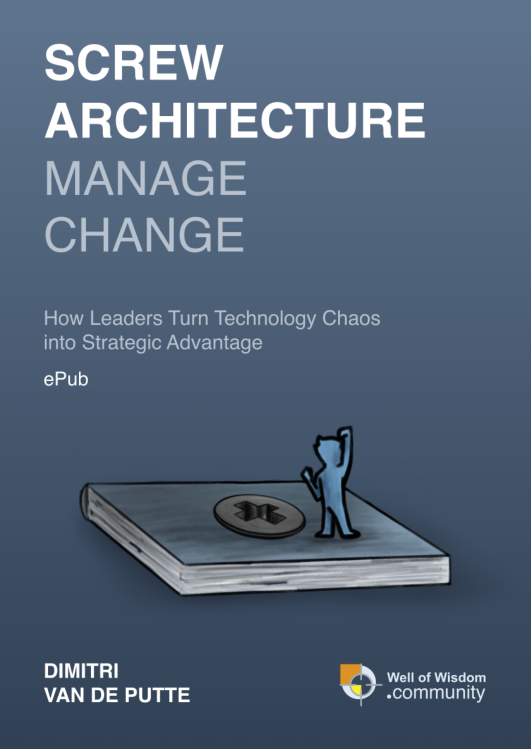
Screw Architecture Manage Change — the CEO playbook, 40 diagrams and the deck. Ebook €24.50, paperback €44.50.
Get the bookOne mail with the chapter, then an occasional note like this one — and €5 off the book when you decide.