
I built a book that answers back

I have a confession about my own book. I wrote ten chapters in the order I thought a reader should walk through them. I am fairly sure almost nobody reads them in that order, with that question in their head.
That is not a flaw in the readers. It is how reading works. You open a book about change with a problem that has a name, a budget and a difficult colleague attached to it. The chapter you land on was written for a different question.
So on 16 November 2026 I did something about it. Screw Architecture, Manage Change now comes with the AI Book: the book you can talk to. You read a page on the left and ask questions on the right. The answers come from the book and name the section they rest on.
 The AI Book comes with your copy: ask it a question, follow the reading path, or open a chapter in outline.
Provided by the author
This post explains why I built it, what it does, and how to use it to read the book faster, better, and applied to your own situation.
Why a book answers back
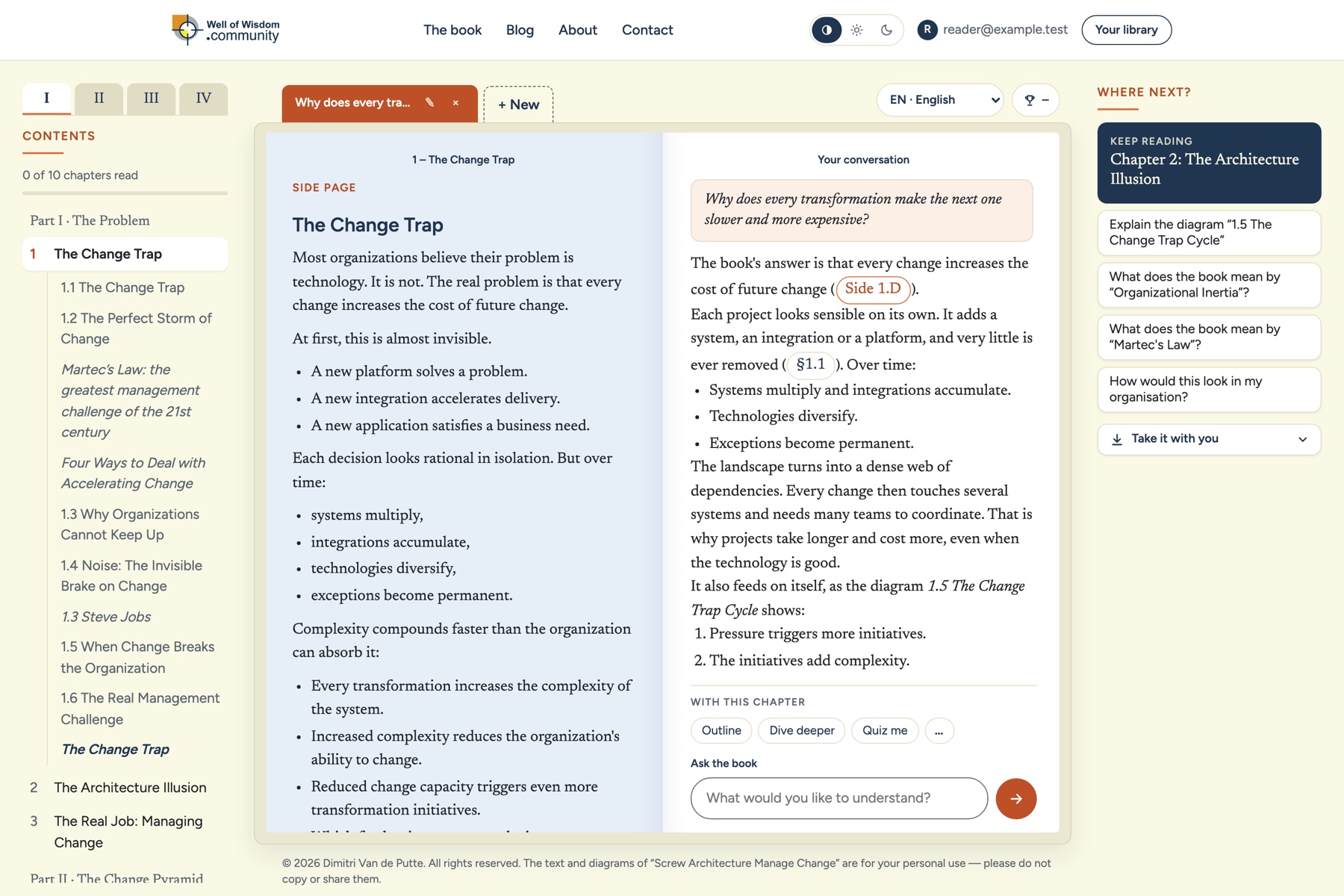 A reader asks why each transformation makes the next one slower and costlier, and the book answers from its own chapter, with links back to the pages it draws on.
Provided by the author
Nobody ever asks the question a chapter was written for. That is true of any book, and it is true of mine.
A printed book has one entry point: page one. An index helps, if you know the word the author used. But the person asking “why is every project in my company slower than the last?” does not know that I call it the Change Trap. They know their own words, their own landscape and their own deadline.
I wanted a book that meets the reader in their words and walks them to the right page in the book’s words. Not a chatbot that knows everything. The book does not need that, and I did not want it. I wanted a chatbot that knows this book, answers only from it, and shows its sources, so you can check me instead of trusting a model.
That last point matters. The book argues that architecture is not documentation, not governance bureaucracy and not a collection of frameworks. An AI that produces fluent text with no source would be the same failure in a new costume: plenty of output, nothing you can verify. So every answer carries references, and every reference is one click from the page it points to.
One live example
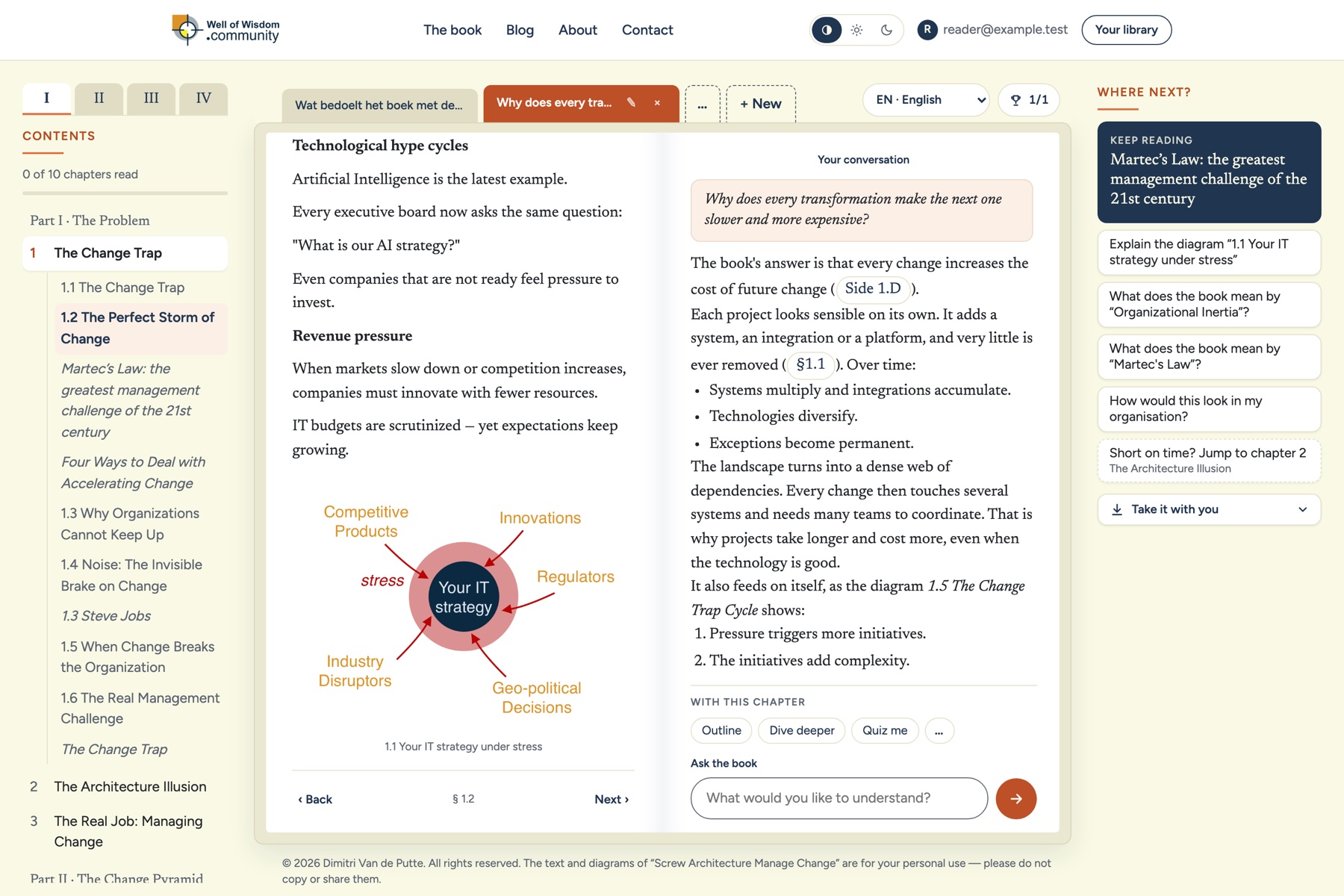 The book open on one screen: the chapter on the left, and on the right its answer to that first question, with links back to the sections it draws on.
Provided by the author
Here is the question I put to it first, because the whole book is built around it: “Why does every transformation make the next one slower and more expensive?”
The answer opens with the book’s position: every change increases the cost of future change, with a reference to Side 1.D. Then it explains how. Each project looks sensible on its own. It adds a system, an integration or a platform, and very little is removed, with a reference to §1.1. Over time systems multiply, technologies diversify and exceptions become permanent. The landscape turns into a dense web of dependencies. Every change then touches several systems and needs many teams to coordinate. That is why projects take longer and cost more, even when the technology is good.
Then comes the part that makes it a trap and not just a mess. It feeds on itself. The answer points to the diagram The Change Trap Cycle: pressure triggers more initiatives, and the initiatives add complexity. The book’s page finishes the loop: the added complexity reduces the organisation’s ability to change, and that reduced capacity triggers even more transformation initiatives.
None of this has to be taken on trust. Every reference in the answer, Side 1.D and §1.1, is a button. Click one and that page of the book opens on the left, while the conversation stays on the right. You can check the answer against the text in a second. If the answer and the book ever differ, the book is right.
Beside the page, the AI Book then suggests what to ask next: explain the diagram, what does the book mean by Organizational Inertia, what does it mean by Martec’s Law, how would this look in my organisation? Those suggestions are not invented by the model. They are built from what is open on your page: its diagram, the concepts the text mentions, and that last, personal question.
Read it faster
Not every chapter deserves your full attention today. Picture ten minutes before a steering committee and a chapter you have not read yet. The AI Book has seven ways to work with a chapter:
- Outline: one or two sentences per section, in order, with references
- Dive deeper: the open section step by step, with its side pages and diagrams
- Quiz me: five multiple-choice questions, one at a time, with the section to re-read
- Guided questions: the tutor asks, you reason, the tutor compares with the book
- Four causes: the idea of the open section as matter, form, what brings it about and purpose
- Fast track: the chapter in 120 words, then what the next chapter adds
- Assess my organisation: the chapter’s principles scored one at a time
Fast track is the one I would start with. It gives you the chapter in 120 words and then tells you what the next chapter adds, so you know whether to go on or jump ahead. Outline gives you the skeleton: one or two sentences for each section, with references you can click when a line catches you. Dive deeper opens only the section you have open, with its side pages and diagrams, step by step.
The reading itself keeps track of where you are. The contents sit beside the book by part and chapter, with your progress (“0 of 10 chapters read” when you start). Back and Next under the page turn the pages in the book’s own order. Where next? shows the next page to read and a shortcut to the next chapter.
Faster does not mean skimming blind. It means you decide where your hour goes.
Read it better
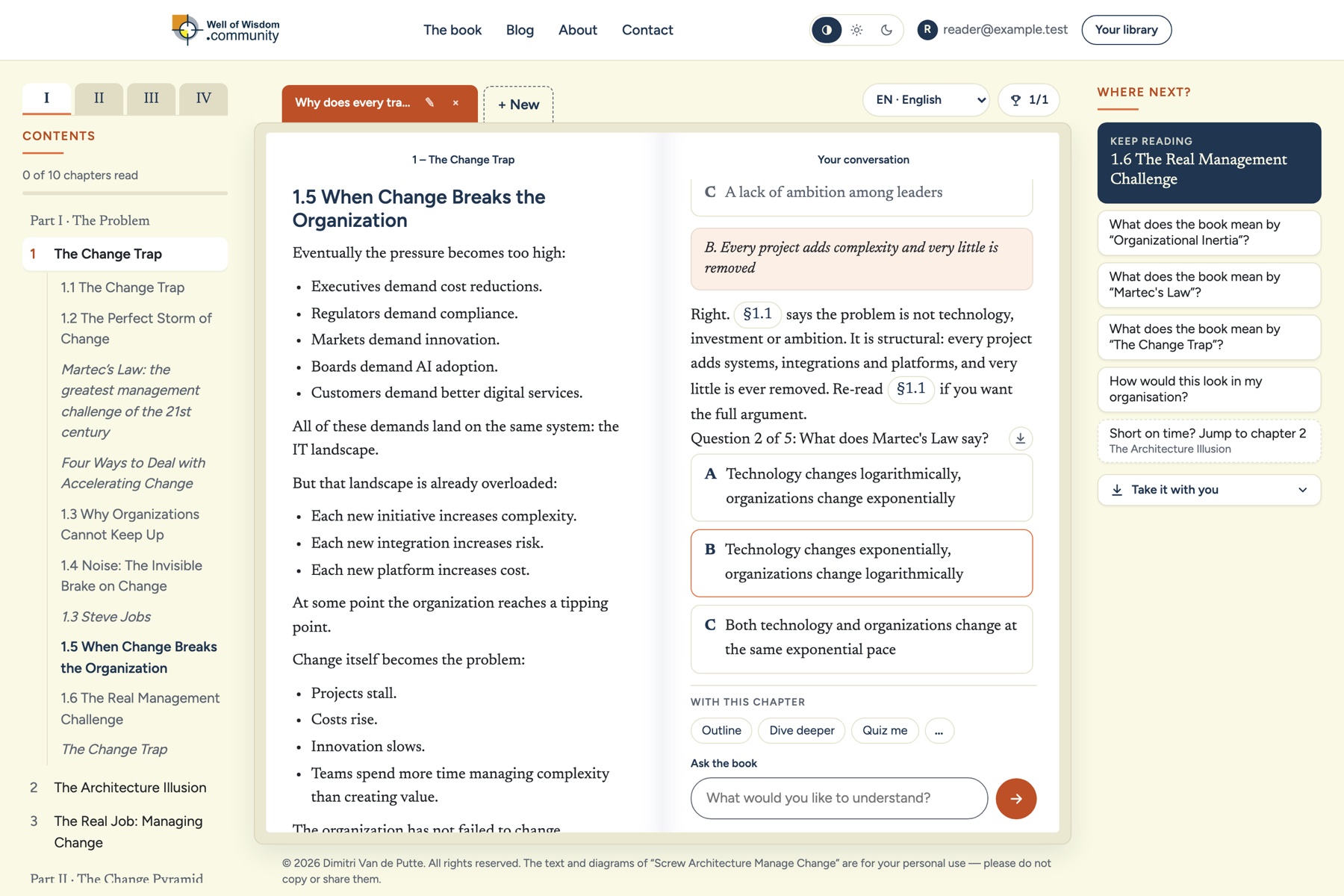 Chapter 1.5 on the left, and on the right a quiz that checks what you just read, with a box to ask the book your own question.
Provided by the author
Faster is only useful if it sticks. This is where the AI Book stops being a search box.
Quiz me asks five multiple-choice questions on the chapter, one at a time. After each answer it checks you against the book and tells you the section to re-read. In my test on Chapter 1, question one asked what the real problem behind slower and more expensive transformations is. A lack of modern technology is the tempting answer. The book’s answer is that every project adds complexity and very little is removed. Question two asked what Martec’s Law says: technology changes exponentially, organisations change logarithmically. Right answers are counted, and a score beside the language shows how you are doing, chapter by chapter.
Guided questions turn the roles around. The tutor asks, you reason, and only then does the tutor compare your reasoning with the book. It is slower than reading and much harder to fake. Four causes looks at the idea in the open section as matter, form, what brings it about and purpose.
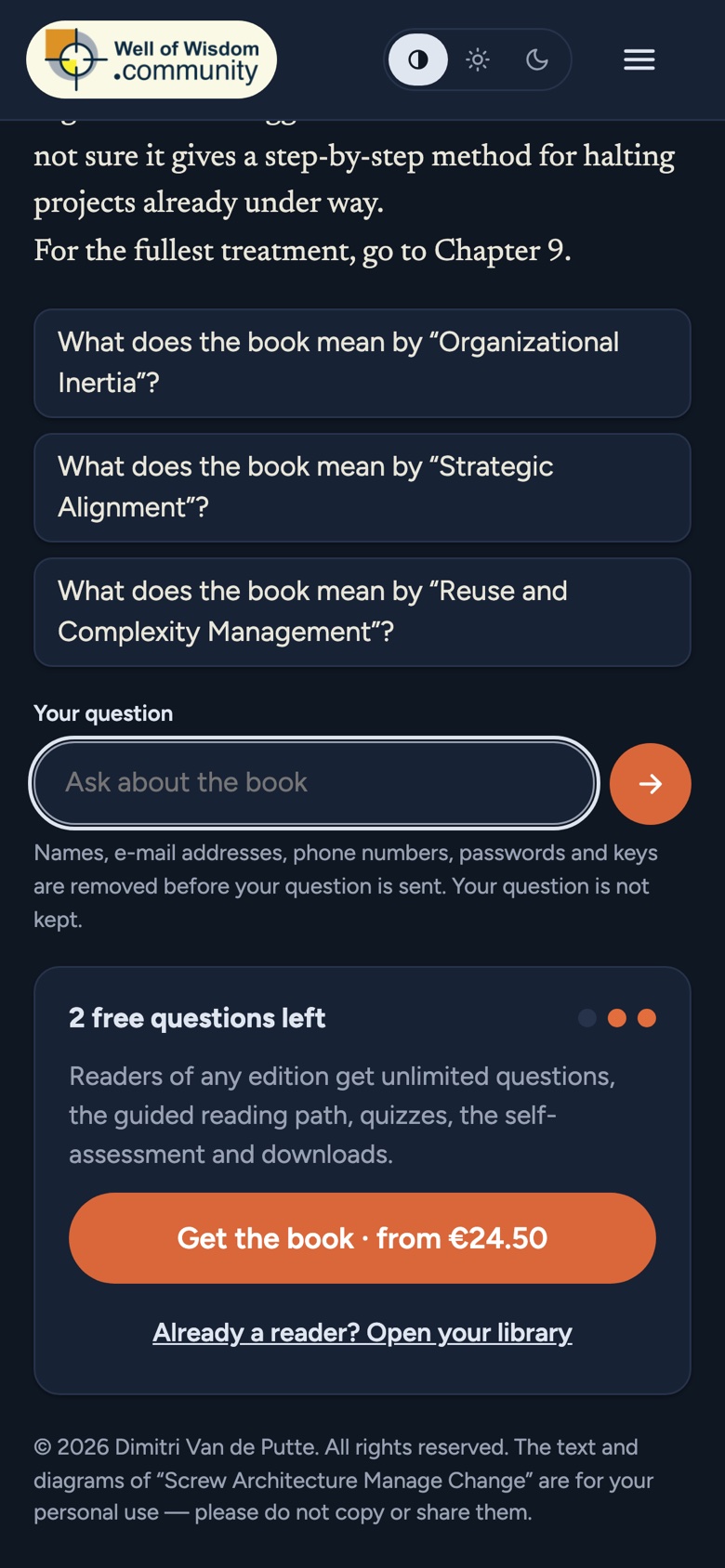
It also tells you when the book does not cover something. I tried this in the free preview with a fair question: “Does the book explain how to decide which projects to stop?” The answer was yes, mostly, through funding and portfolio choices before projects start. It pointed to the portfolio compass in §9.2, where leadership picks one direction for each capability at least every two years: Invest, Modernize, Maintain or Retire. It added the three questions of §7.4: Why are we changing? How will we change? What will the long-term impact be? And then it said it was not sure the book gives a step-by-step method for halting projects already under way.
I prefer that sentence to a confident invention. When no passage fits, the AI Book says so and offers the contents instead of guessing.
Apply it to you
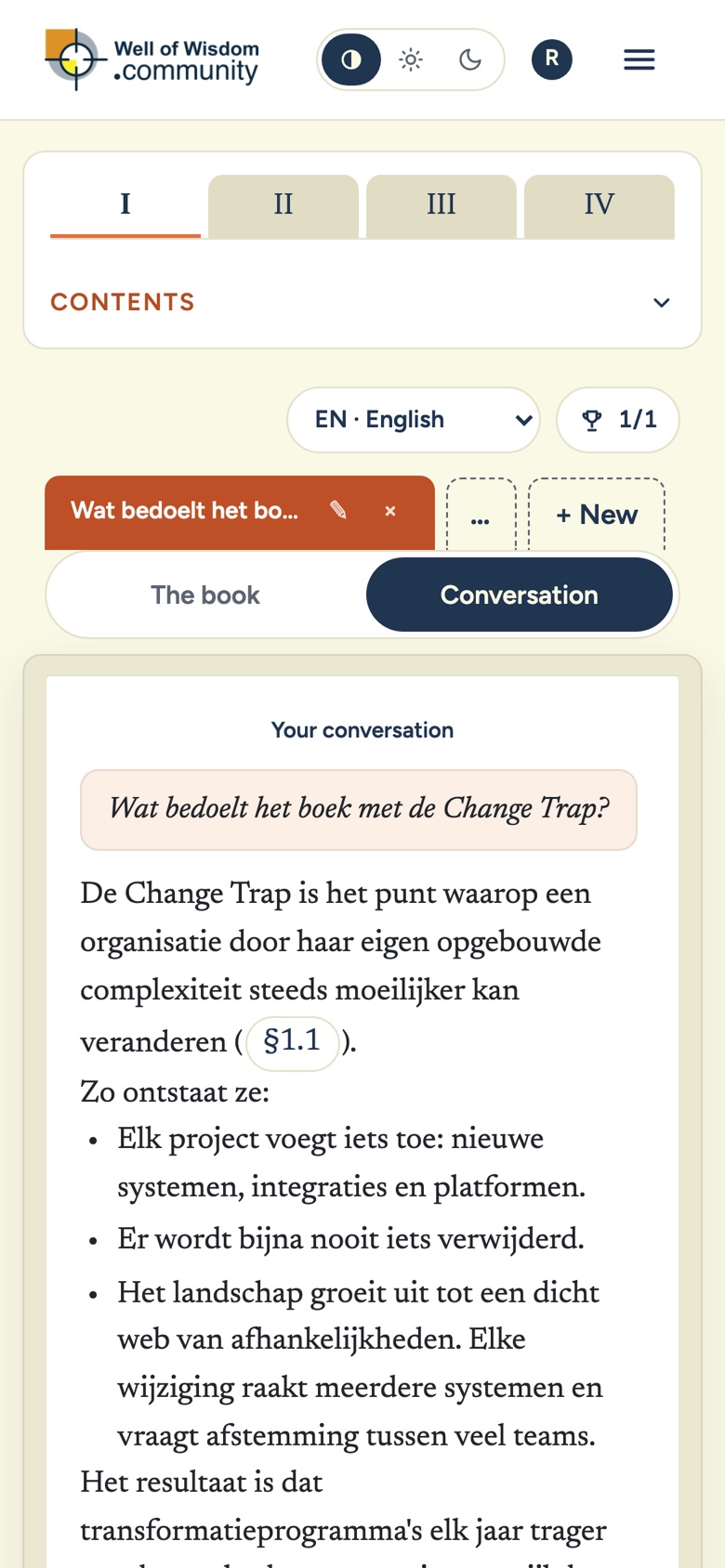 Ask the book about your own situation: here a reader asks, in Dutch, what the Change Trap means and gets an answer that points back to §1.1.
Provided by the author
A book about change is only worth the change it causes in your own organisation. This is where the AI Book earns its place.
Start small. Ask: “How would this look in my organisation?” Or be blunt. In one test conversation I typed: “My manager says architecture only slows us down. What does the book say to that?”, with a name, an organisation and an e-mail address thrown in.
The book agrees with your manager about a lot of architecture as it is practised, and then argues for a different kind. Where it agrees, Chapter 2 calls this the architecture illusion: architecture looks mature and structured, but it does not reduce complexity, speed up decisions, anticipate change or lower cost.
Score yourself in ten minutes
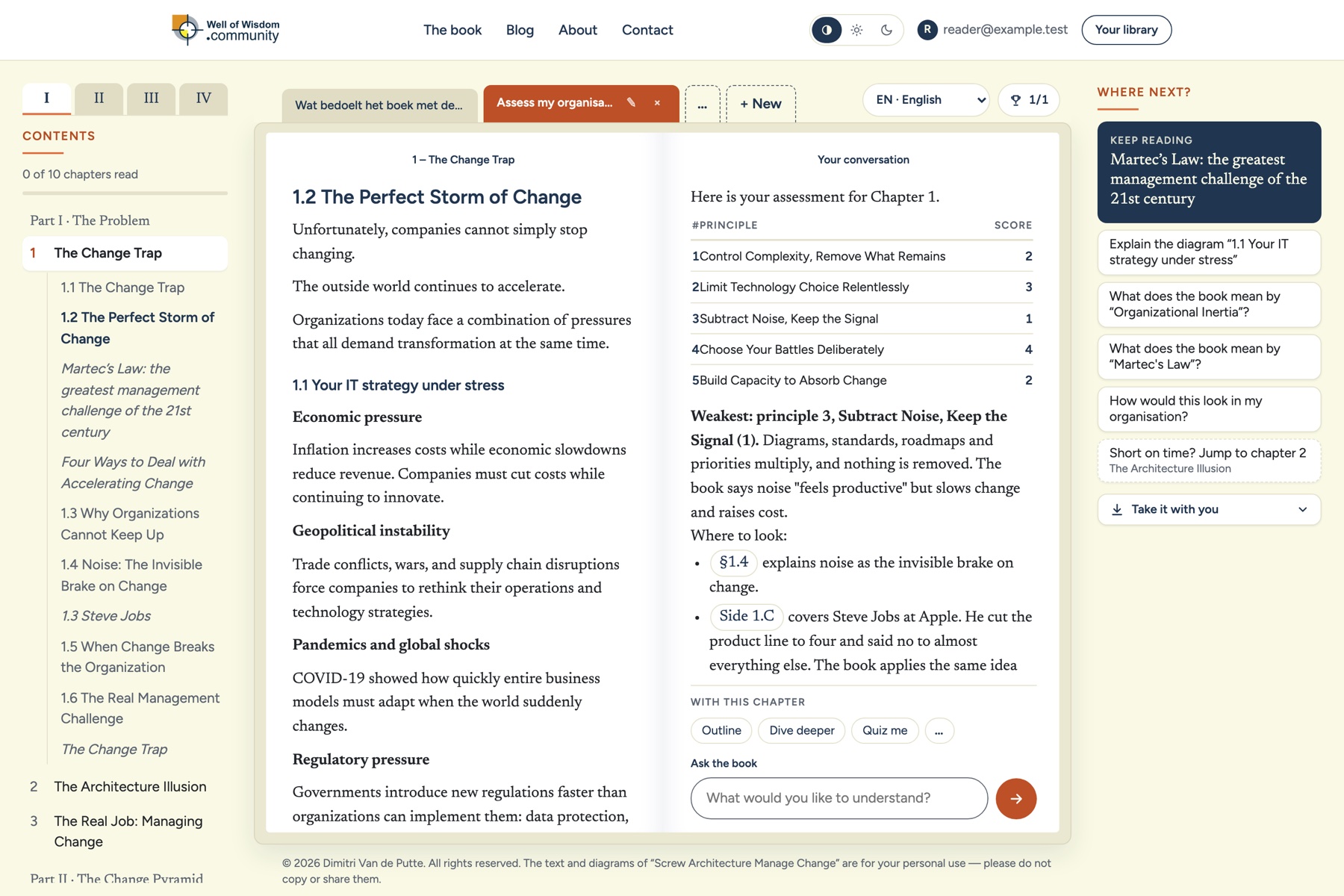 The book scores a leader’s answers on five principles. Here, principle 3, Subtract Noise, comes out weakest.
Provided by the author
Now the exercise I would ask every leader to do. It takes ten minutes.
- Open the AI Book and go to Chapter 1, The Change Trap.
- Press Assess my organisation among the chapter buttons.
- The five principles of the chapter come one at a time. Pick a score from 1 to 5 for each.
- Read the result: a table of your scores, your weakest principle and the sections to read about it.
In a test run on Chapter 1, I scored like this:
- Control Complexity, Remove What Remains: 2
- Limit Technology Choice Relentlessly: 3
- Subtract Noise, Keep the Signal: 1
- Choose Your Battles Deliberately: 4
- Build Capacity to Absorb Change: 2
The AI Book named the weakest point: principle 3, Subtract Noise, Keep the Signal, scored 1. Its reading: diagrams, standards, roadmaps and priorities multiply, and nothing is removed. The book says noise “feels productive” but slows change and raises cost. Then it told me where to look: §1.4, which explains noise as the invisible brake on change, and Side 1.C, which covers Steve Jobs at Apple, who cut the product line to four and said no to almost everything else.
That is the diagnosis and the reading list on one screen. The scores are kept with your quiz score, so you can come back and score again. Chapter 1 has five principles. The book has 42, grouped by the ten chapters, each written as a statement your organisation can be held against. The full set of 42 comes with every copy. A self-assessment is not an audit, but it tells you which page to open on Monday.
Take it with you
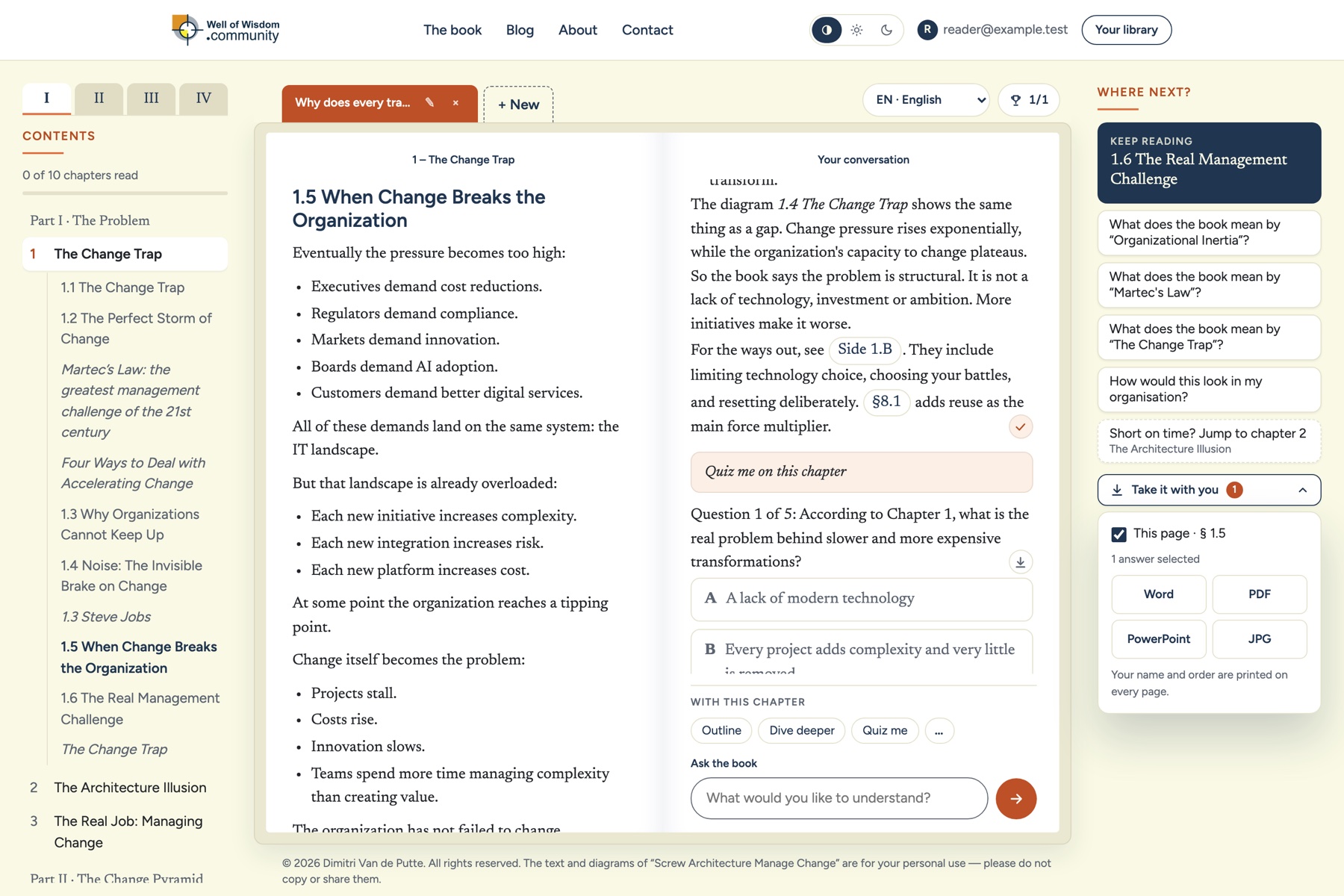 The “Take it with you” menu on page 1.5: one selected answer, four file formats, and a note that your name and order are printed on every page.
Provided by the author
A good answer should not die in a browser tab. “Take it with you” makes a file of the open page, with its diagrams, the answers you selected and the passages you marked on the page. The formats are Word, PDF, PowerPoint and JPG. Each file is personal: your name and order are printed on every page.
The AI Book speaks seven languages: English, French, Dutch, German, Italian, Spanish and Portuguese. The buttons, the questions beside the book and the answers follow the language you choose. The pages of the book stay in English. I asked in Dutch what the book means by the Change Trap and got the answer in Dutch, with the same clickable §1.1.
It works on a phone too, one page at a time, with a switch between “The book” and “Conversation”.
What it will not do
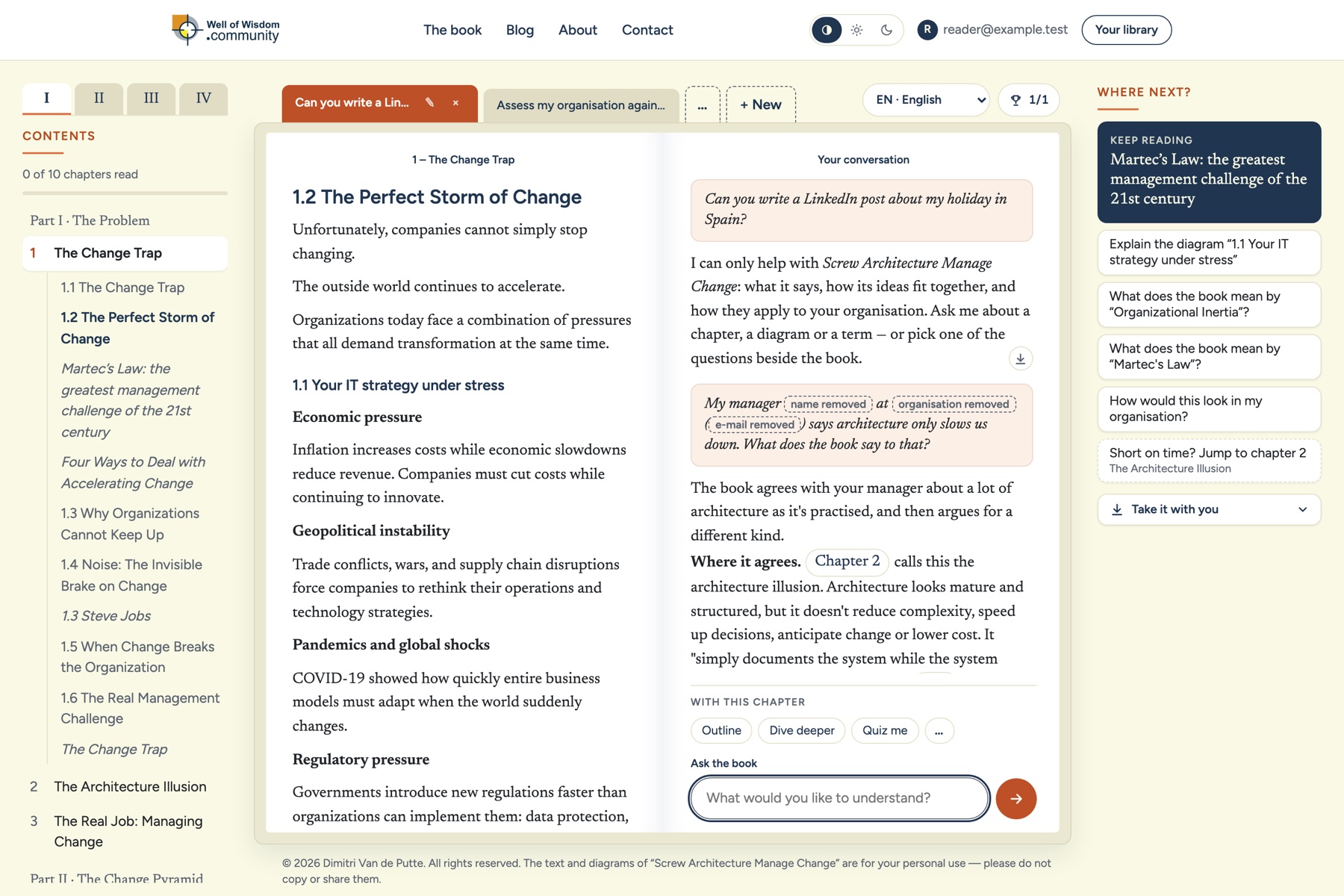 Ask it for a holiday post and it declines, and points you back to the book.
Provided by the author
Allergic to theatre as I am, I want to be as clear about the limits as about the features.
It talks about the book only. Every message is checked before it is answered. When I asked it to write a LinkedIn post about my holiday in Spain, it said it can only help with Screw Architecture, Manage Change: what it says, how its ideas fit and how they apply to your organisation. A fixed reply, pointing back to the book.
It does not keep personal details. Before a message is stored or answered, names of people, e-mail addresses, phone numbers, bank and card numbers, passwords and keys are replaced by a marker such as “name removed”. The names of your own organisation, clients and suppliers are masked as well.
It does not copy out the book: a request to print a chapter word for word is refused. It has no web access and no files.
It is not advice. The answers are written by an AI model (Claude, by Anthropic) and can be wrong. Where an answer and the book differ, the book is right.
Conversations are removed three months after last use, and you can download or erase them and your scores from the Library; an erasure takes effect at once. The privacy notice also says that I can read stored conversations, with personal details already removed, and that questions are processed by Anthropic and OpenAI in the United States.
Honest limits
Three limits to know. Readers can ask up to 60 questions a day. In a month of very heavy use the AI Book can pause until the first of the next month, while the pages of the book stay open. And two things are not available yet: access for people who bought the book elsewhere, because it is sold only on the site for now, and using the book from your own AI tool, which is built but not opened.
Try it, then get it
 Provided by the author
Not sure yet? Ask the book three questions a day, free, at wellofwisdom.community/ask. No account, and it is made for a phone. Each answer is short, with the sections it rests on and the chapter that goes deeper. Nothing you type is kept. The preview leaves out the pages of the book, the quiz, the self-assessment and the downloads. Those are for readers.
Readers get all of it. The AI Book is included with every copy, at no extra price and with no subscription. You sign in to the Library with a one-time link sent by e-mail, and the card “The book that answers back” opens it.
- Ebook, €24.50: https://wellofwisdom.community/b/samcebook
- Paperback, €44.50, ebook included: https://wellofwisdom.community/b/samcpaperback
- The site, the blog and the free preview: http://wellofwisdom.community
Open Chapter 1, ask the question you walked in with, then score your organisation. Ten minutes. Which principle got your 1?
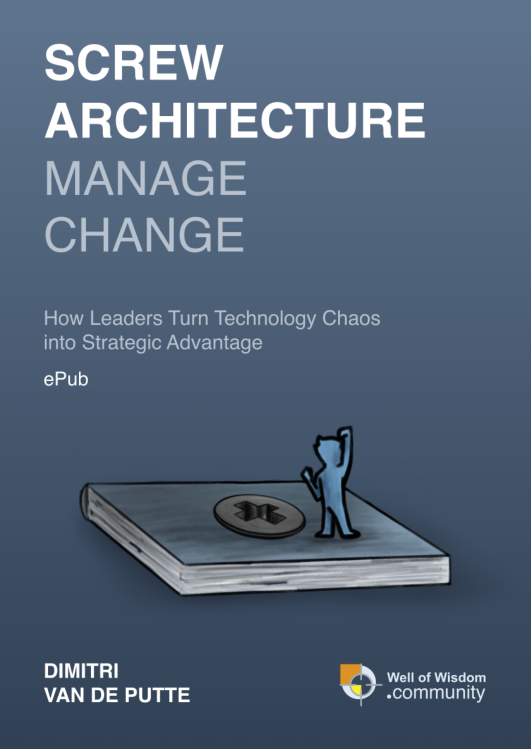
Screw Architecture Manage Change — the CEO playbook, 40 diagrams and the deck. Ebook €24.50, paperback €44.50.
Get the bookOne mail with the chapter, then an occasional note like this one — and €5 off the book when you decide.