
Nobody talks to a model: you talk to a harness

On 29 October I stood on stage at the IIBA Geneva business analysis congress, next to Claude Duc. The talk was about augmented analysis with AI, and the content was a live demo: how a company can optimise a process with an AI that works on its own facts.
It would be easy to file this under business analysis and keep it away from my book. Please don’t. The principle is the one in Screw Architecture Manage Change: decide on facts, document the decision instead of the paperwork around it, and check afterwards whether the decision delivered.
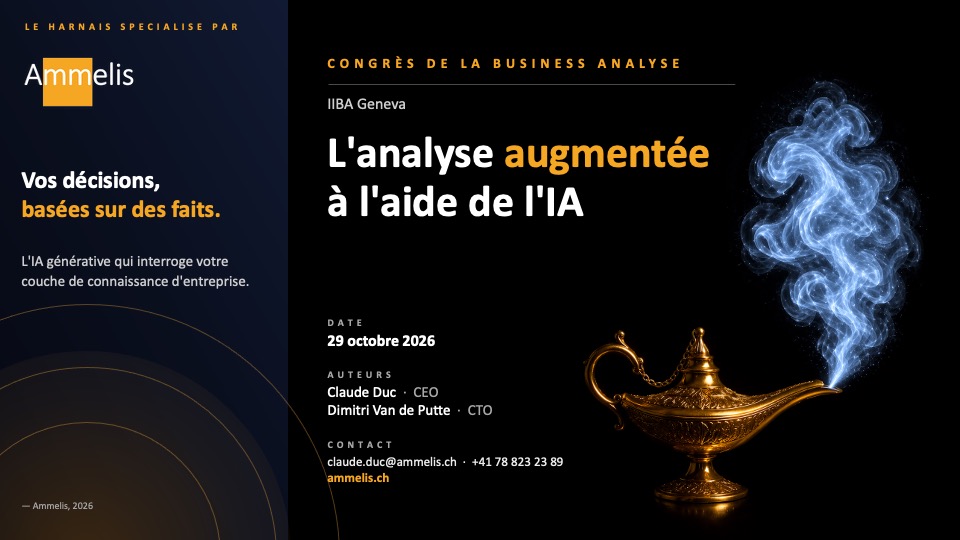 The slide that opened the talk: a genie lamp for the AI, and a promise that decisions rest on facts.
Provided by the author
Here is what I would keep from the talk. Each idea is a small version of an argument from the book.
Nobody talks to a model
One slide in our deck says it in one line: nobody talks to a model, you talk to a harness.
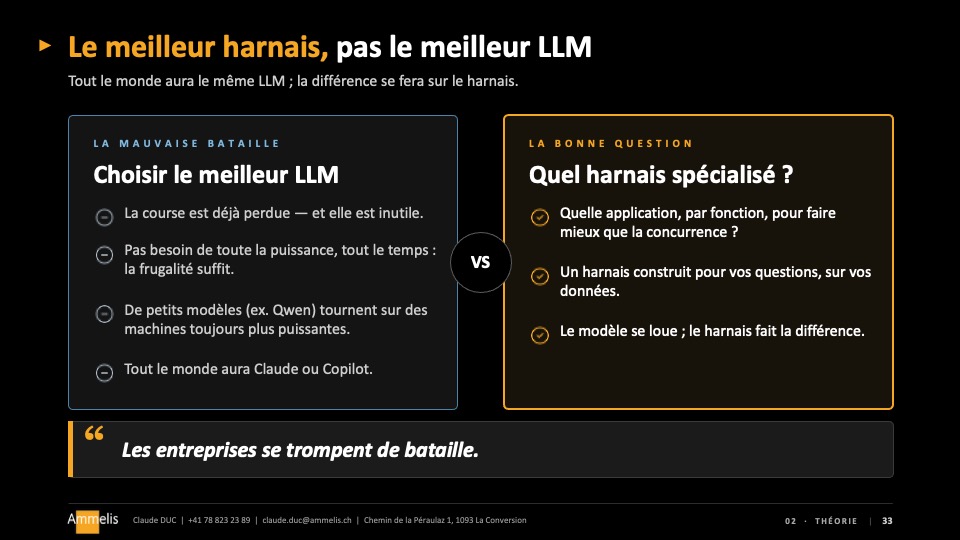 The slide in question, in French: the wrong battle is choosing the best LLM, the right question is which specialized harness to build around it.
Provided by the author
When you type into ChatGPT, Claude.ai, Copilot or Gemini, you are talking to an application built around a language model: a system prompt that gives it a role and rules, tools that let it read and write, a memory, an interface. Claude Code, Cursor, Perplexity and Copilot 365 are harnesses too. The model is one component inside.
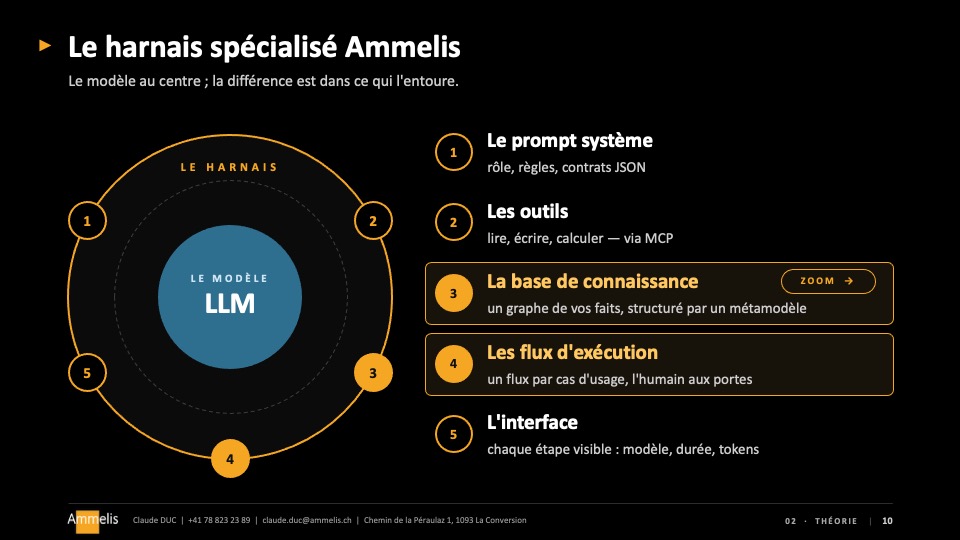 The slide in French: the model sits in the middle, and the five bricks of the harness (system prompt, tools, knowledge base, execution flows, interface) sit around it. Bricks 3 and 4 are highlighted.
Provided by the author
Our slide draws it as a circle, the model in the middle and five bricks around it: the system prompt, the tools, the knowledge base, the execution flows and the interface. The model is a commodity. Claude, GPT, Gemini or a local one: in our harness it is a drop-down menu, not a project. The line on the slide: the model is rented, the knowledge base is owned.
That is a deliberate provocation. In every company I hear the same debate: Copilot or Claude, months of workshops, a steering committee. Wrong question. Whoever leads this quarter gets overtaken next quarter. Ask which harness lets you swap the day somebody else is better.
If that sounds familiar to readers of the book, it should. The book attacks architecture that produces artifacts instead of decisions: the beautiful diagram, the repository nobody consults. A fluent LLM answer is the same kind of artifact. It looks impressive, costs almost nothing, and on its own changes nothing. The value sits around it: the gates where a human decides, and the layer that remembers why.
Why a dedicated harness
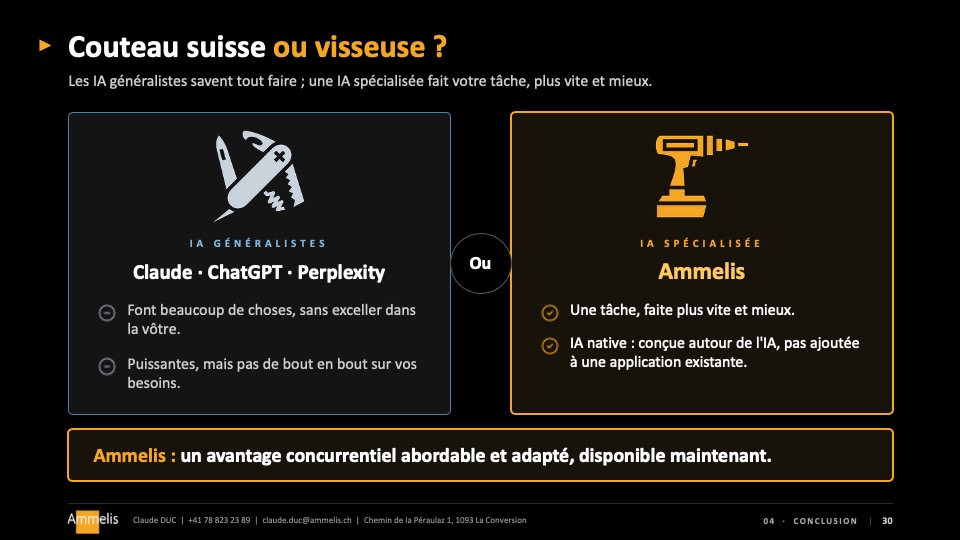 Swiss army knife or drill? General assistants do a bit of everything; a specialised harness does your one task better.
Provided by the author
Fair objection: Claude and Copilot are harnesses too, so why build your own? Because they are general purpose. They do many things and excel at none of yours.
Take the analyst’s daily work. In a generic chat, your files are attachments. Long inputs get summarised, and summaries lose the figures and the facts. Nothing is versioned. Ask the same question next week and the path to the answer is different. That is fine for drafting an email. It is not fine for a decision you will have to defend.
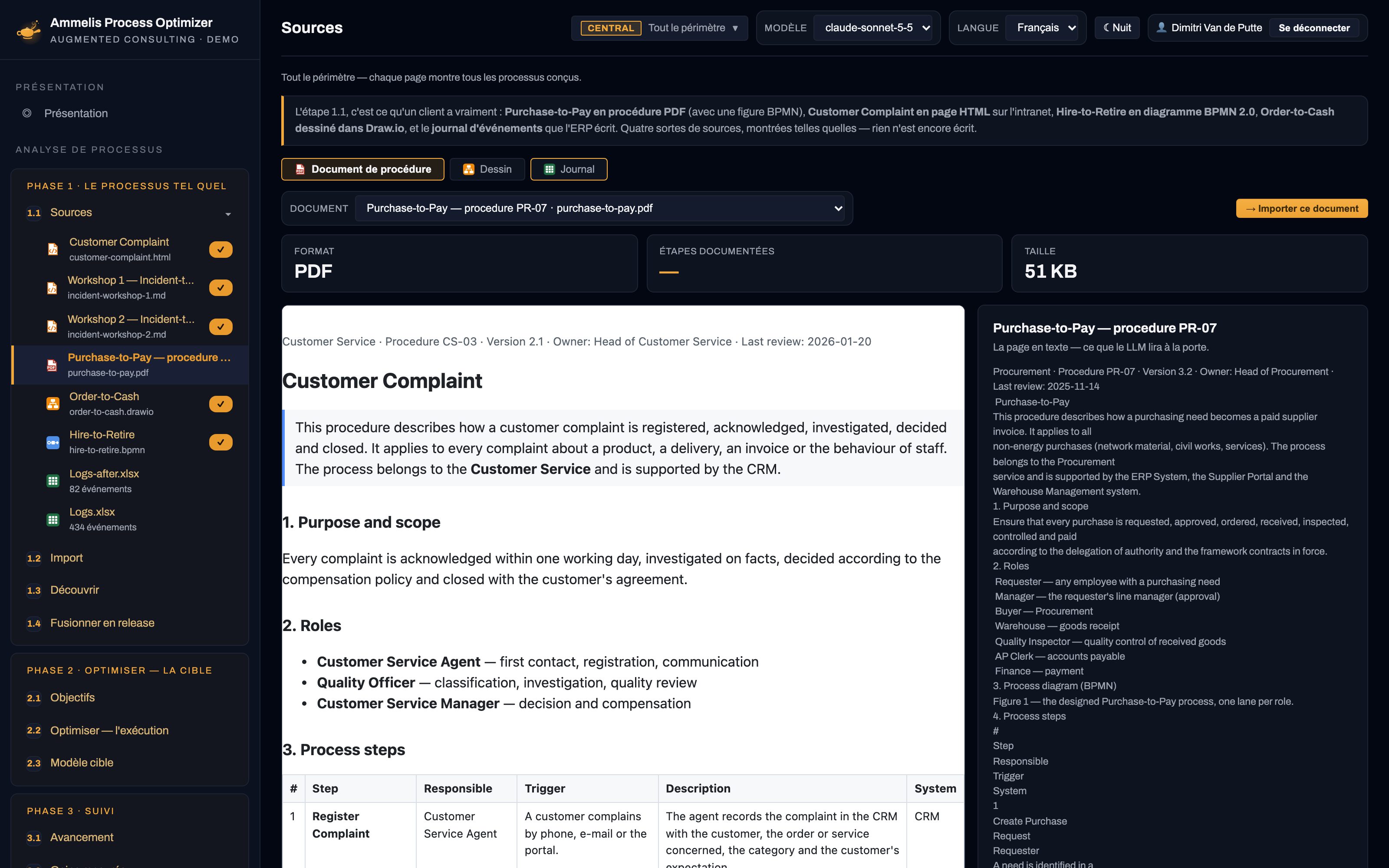 A dedicated harness keeps each source as a named file you can open and check, here a procedure PDF, and shows the text the model will actually read.
Provided by the author
A dedicated harness turns this around. It is your tool and your data, and the facts are computed rather than recalled: the model does not read a million log lines, it writes the code that does, and an algorithm returns the numbers.
The mechanism that makes this work is the execution flow. A use case is not a conversation, it is a flow of steps executed one by one. There are three kinds of node: a call to the model, under contract; a deterministic tool; and a gate where a human reads, corrects and approves. A flow stops at a gate, keeps its state, and resumes when you answer. Every node shows its model, duration and tokens, live.
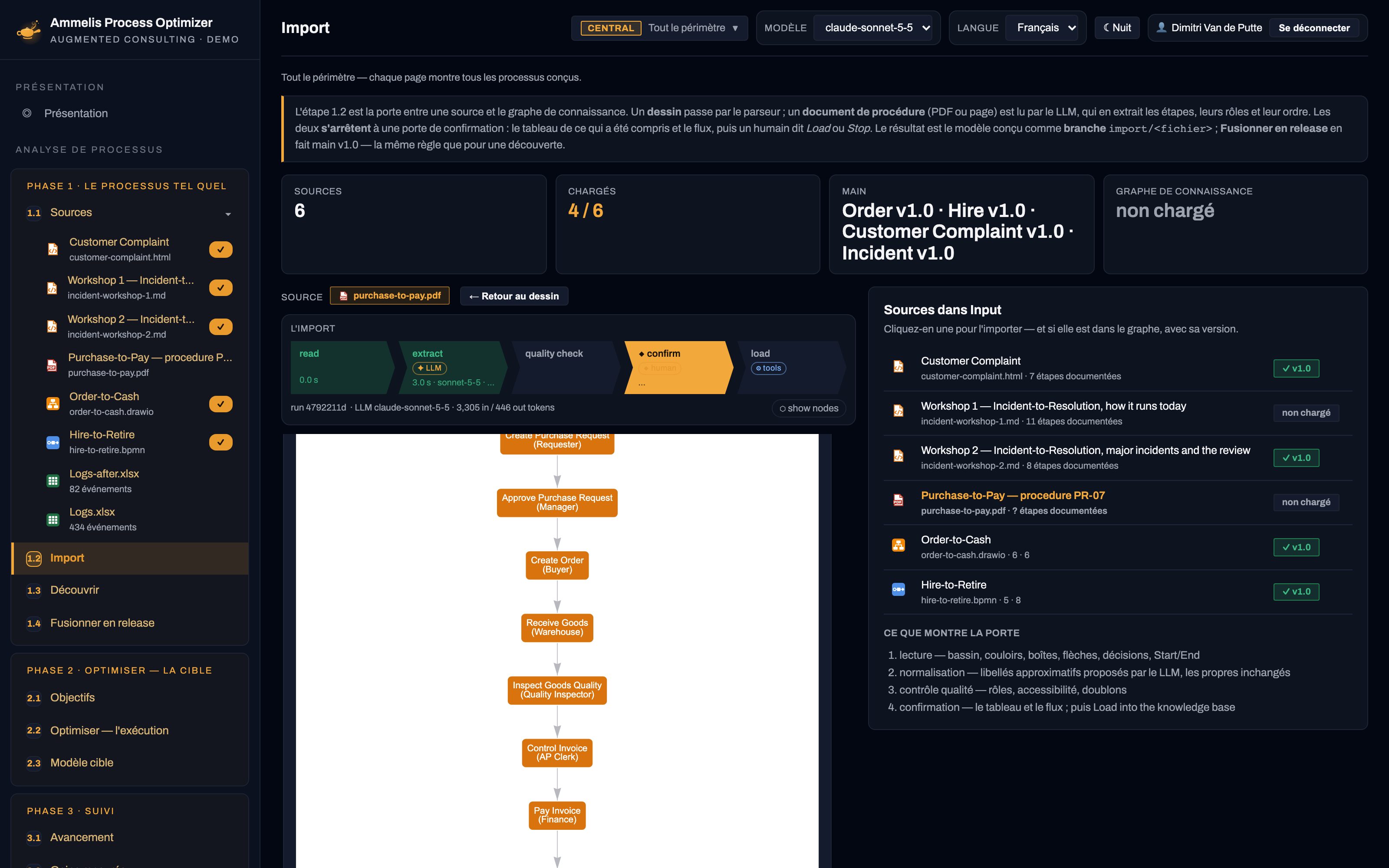 An import run as a flow: read, extract with the model, check quality, then stop at a human confirm gate before loading. The extract node shows its model, duration and tokens.
Provided by the author
Why bother? Four advantages:
- Repeatable: the same use case runs the same way every time.
- Controlled: the human sits at the gates, not after the fact.
- Auditable: who decided what, and when, is traced.
- Improvable: you change one step without redoing the rest, and each step gets the model it deserves. In the demo a full loop costs about twenty cents.
We say execution flow on purpose, not process and not graph, because the company’s own processes are the thing being analysed. The flow is the process that executes the analysis. Claude Duc put it well: the analyst’s job tomorrow is to design these flows, and to decide at each step what the AI does and what the human does.
Own the system of record
Here is the part I care about most after thirty years in architecture. Where do the facts live?
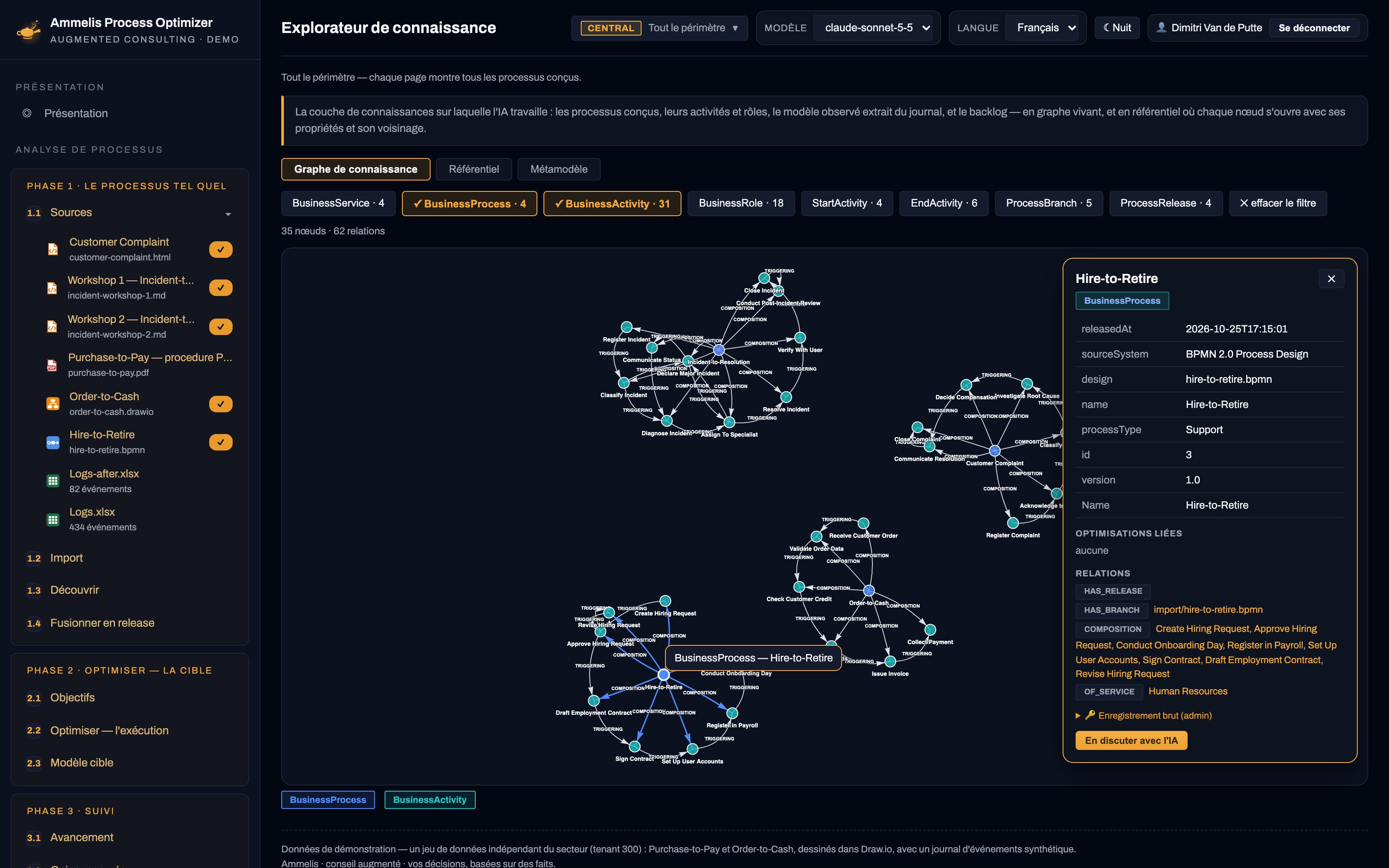 The facts live in a graph, not in a prompt: here the Hire-to-Retire process opens onto its source file, version, release and linked activities.
Provided by the author
In our harness they live in a knowledge base: a graph of your facts, structured by a metamodel that imposes the shape, so the AI does not decide how your enterprise is organised. A query returns facts or nothing, never a plausible sentence. Every number can be traced to its source node, with its history. Everything is versioned, and every decision is a branch with its trail.
That graph is your system of record, deliberately independent of the AI revolution around it. Think in layers that move at different speeds. The model changes constantly, at the speed of the market, and will become a crowd of interchangeable models. The harness and its flows are experimental: you adapt them as you learn. The knowledge base is the slow layer, and it must outlast both. It is the same logic as the book’s documentation proportional to pace: invest where information lives long.
Sovereignty follows from that. Hosting is your choice, including local, with a local model if you want. The model never reaches your sources directly, it works through tools. Graph, files and prompts belong to you, so there is no lock-in when a vendor changes its pricing or its interface overnight. And if your competitors use the same off-the-shelf harness as you, you have no advantage. What is unique is your knowledge and your flows.
Facts arrive too late
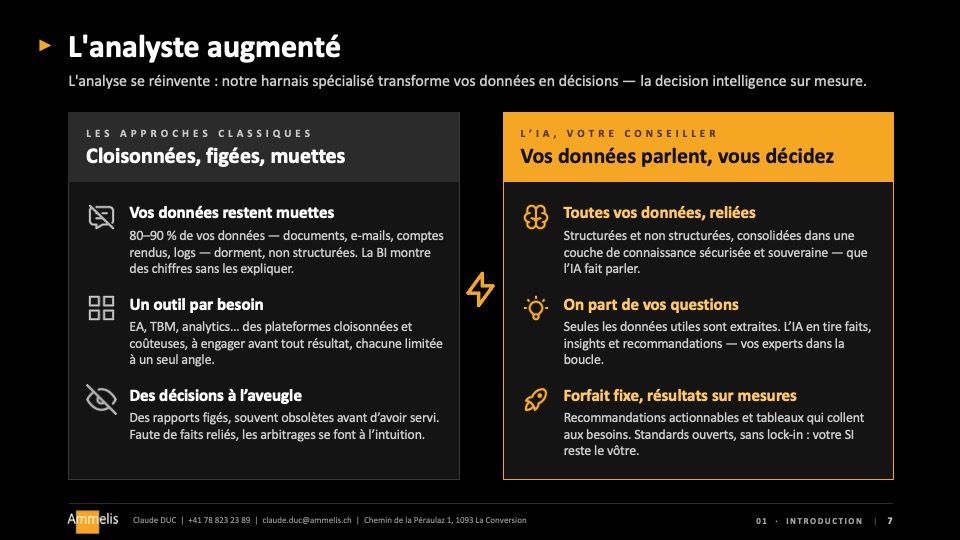 The slide from the talk: on the left, data that stays silent and reports that arrive after the decision; on the right, connected data that answers the questions asked.
Provided by the author
Claude Duc has twenty-five years in business analysis and nine company refits lived from the inside. I have thirty years in enterprise architecture. Preparing the talk, we compared notes and the conclusion was uncomfortably simple: in none of those refits did technology block the decision.
The facts already existed, in procedures, e-mails, minutes, logs and people’s heads. They reached the table after the committee had decided, or never. I have watched a committee choose a portfolio from a deck three weeks old while the answer sat in transcripts nobody could read at scale. One slide puts a number on it: 80 to 90 per cent of your data sleeps unstructured in documents, e-mails and logs.
I call this Organizational Disconnect. It is not a data problem. Deciders and fact-holders are connected by slides and a calendar, and a dashboard answers a question somebody anticipated six months ago. So our position is blunt: AI should answer questions, not produce more dashboards. Start from the question the decision needs answered, extract only what is useful, and keep your experts in the loop.
The loop that documents itself
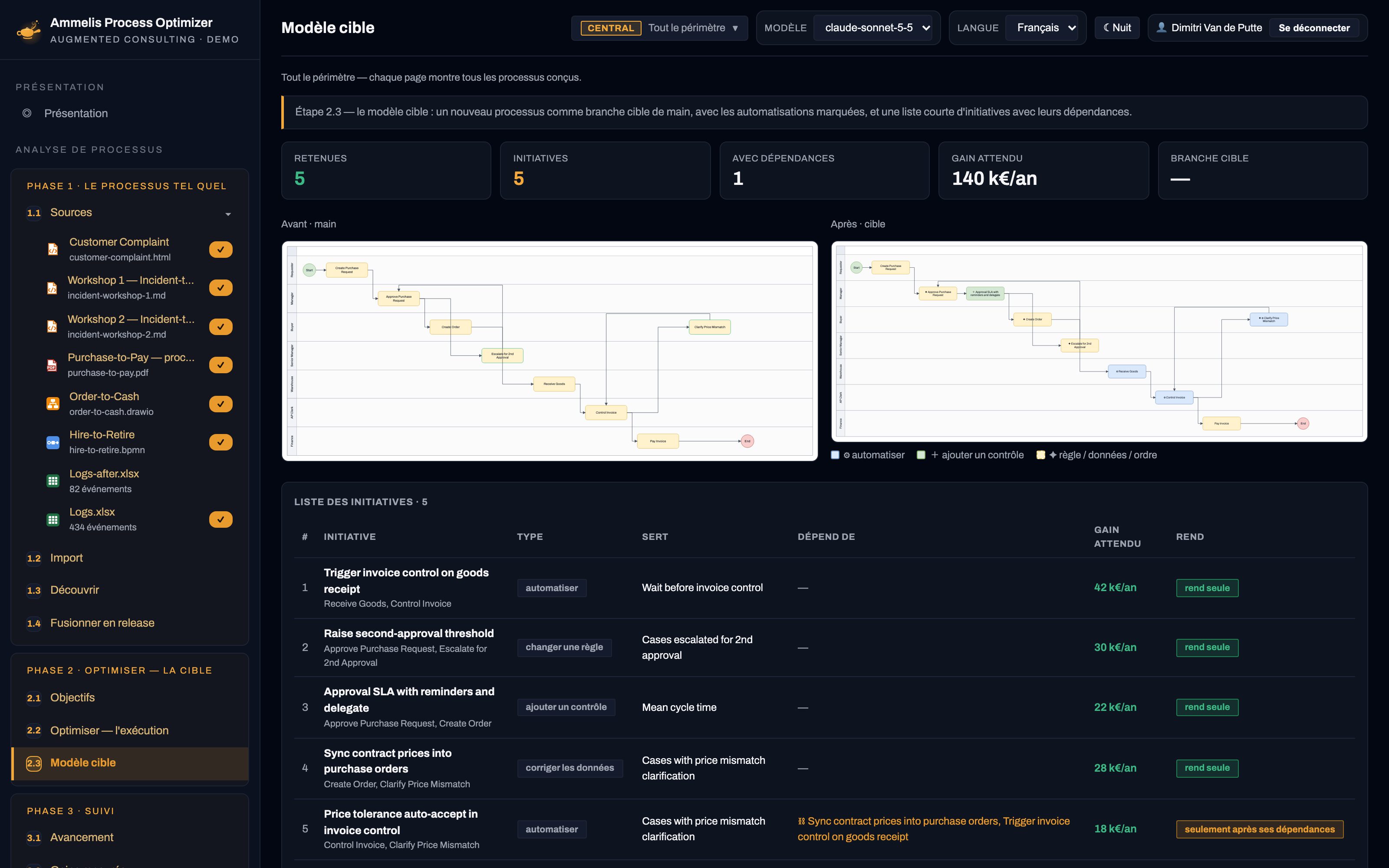 The demo screen: a target process drawn next to the current one, and five initiatives listed with their dependencies and expected gains, 140 k€ a year in total.
Provided by the author
Here is the demo that carries the argument. The question I put to the room: what if the documentation wrote itself as a by-product of deciding?
The case is Purchase-to-Pay, the process every company has and few trust. Two sources describe it. The first is the procedure, a PDF from procurement with its BPMN figure: how the process is supposed to work. An import flow extracts activities, roles and flow, a gate shows the result, a human confirms, and it is published as a branch. Main stays untouched.
The second is the event log: what people actually did, case by case. A discovery flow proposes the column mapping, the human validates, and a plain process-mining algorithm computes the flow as lived, with its numbers. Another branch.
Then the release screen shows main and the branch as swim lanes. Green is what the log brings. Red dashed lines are what the procedure foresees and nobody performs. The log revealed steps the procedure never mentions, such as a price mismatch clarification and a second-level escalation. A release gate lists everything about to be merged, one tick box per element. A human ticks. Main gets v1.1.
Nobody wrote a document. Yet the base holds the designed process, the observed one, the differences, and who accepted what. That is the book’s rule: document decisions and the why, be proportional, create once from sources that already exist. And its blunt line: unused documentation is inventory, and inventory without value is waste.
Optimise on objectives
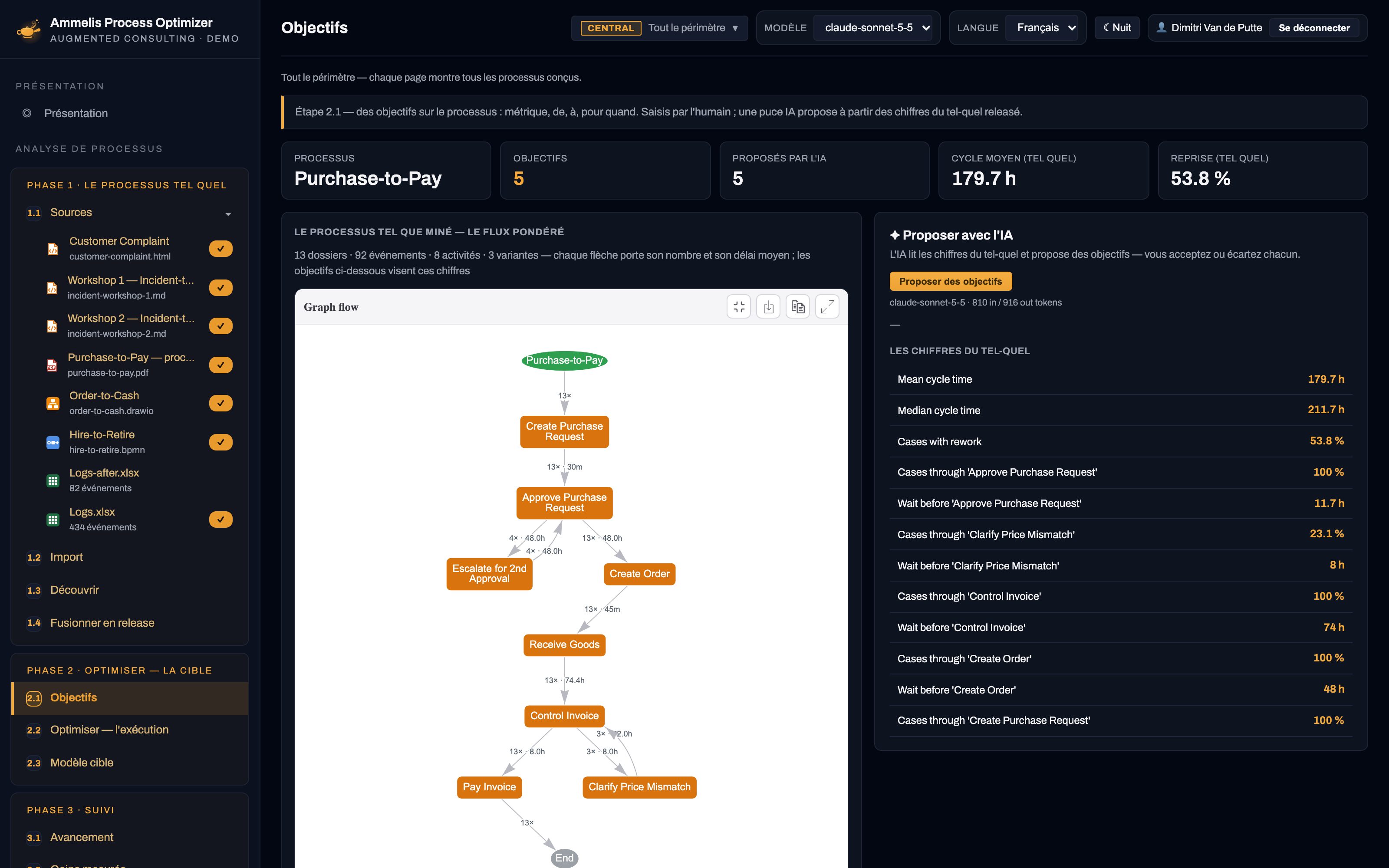 The objectives step in the tool: the mined as-is figures sit next to the flow graph, and the AI reads them to propose targets that you accept or drop.
Provided by the author
In phase two, objectives attach to the mined numbers: mean cycle time from 179.7 to 130 hours, wait before invoice control from 74 to 36, cases with rework from 53.8 to 30 per cent, escalations to second approval from 30.8 to 15, price mismatch clarifications from 23.1 to 12. The AI proposes, the human accepts or drops each one.
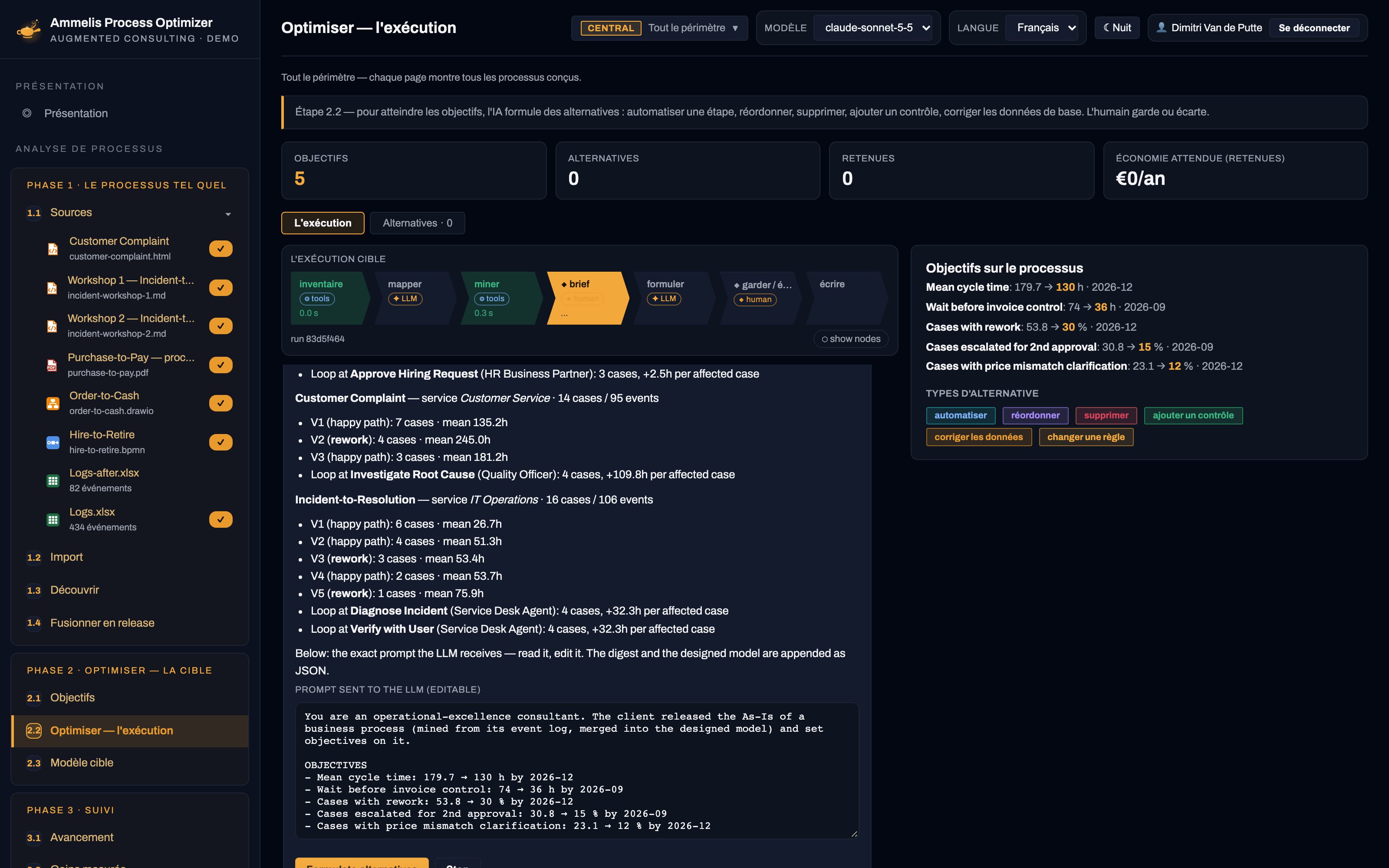 The gate before the question is sent: the five objectives sit inside a prompt that can be read and edited, and no alternatives exist yet.
Provided by the author
One question goes to the model, and the exact prompt is shown at a gate, to read and edit before it is sent. Alternatives come back under contract: evidence, effect, estimated gain. Trigger invoice control on goods receipt. Sync contract prices into purchase orders. Auto-accept small price deviations within a tolerance. The human ticks, and the target model is released as a branch. A harness that shows its prompt is one you can argue with.
Check the decision afterwards
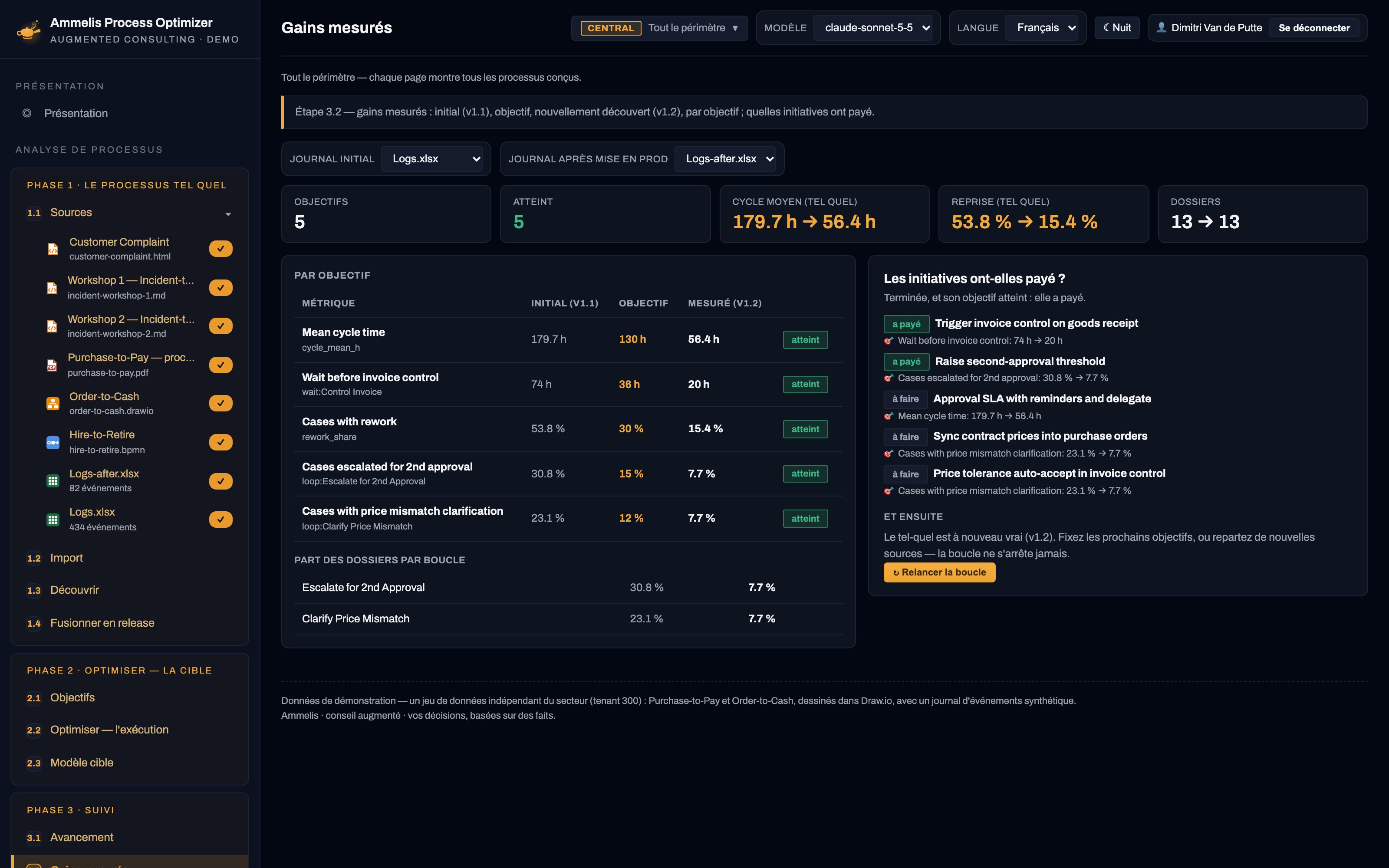 The gains page from the demo: five objectives, each with its before, target and measured value, all marked reached. Two initiatives are marked paid, three still to do.
Provided by the author
Most programmes end at go-live. This loop does not. Initiatives get an owner, a due date and a status. When IT delivers the post-go-live log, discovery runs again on it: a new branch, release v1.2. The gains page sets the two logs side by side, per objective: before, target, measured. Every objective reads reached or missed. In the demo they are reached. In real life some will be missed, and seeing that is the point.
Claude Duc translated COSO’s 17 principles into 40 questions, with a critical path and ten work packages. The fundamental one: are your modeled processes your real processes? If the procedure says one thing and the log another, every control built on the procedure is theatre. A saving nobody measures afterwards is a belief.
I meet leaders who fund transformations and never check whether the gains happened. No baseline, no second log. The change engine in the book ends on the same question: did the change create value? And release v1.2 is built on v1.1. That is knowledge reuse, not another slide deck.
What to take away
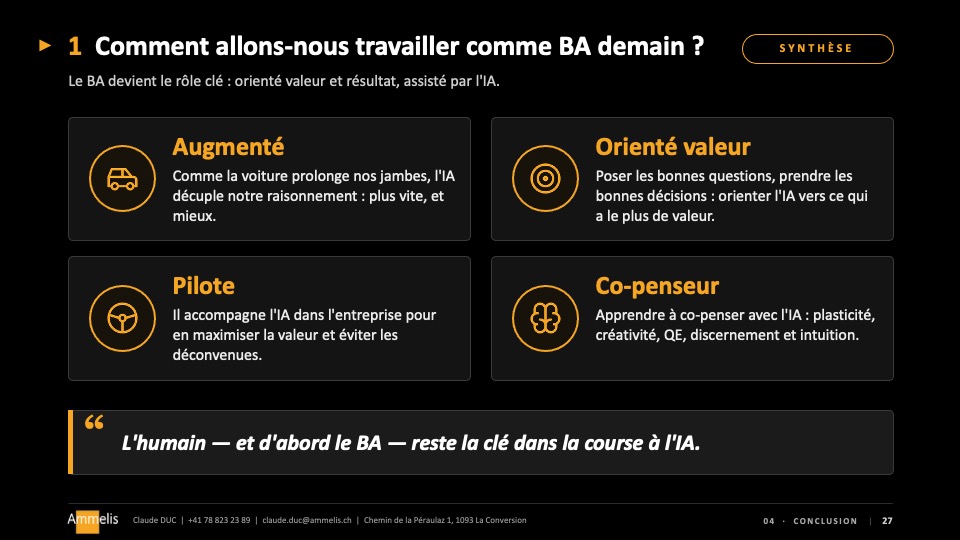 Before the checklist: the slide’s own answer is that the business analyst stays in charge, as the pilot and co-thinker of the AI.
Provided by the author
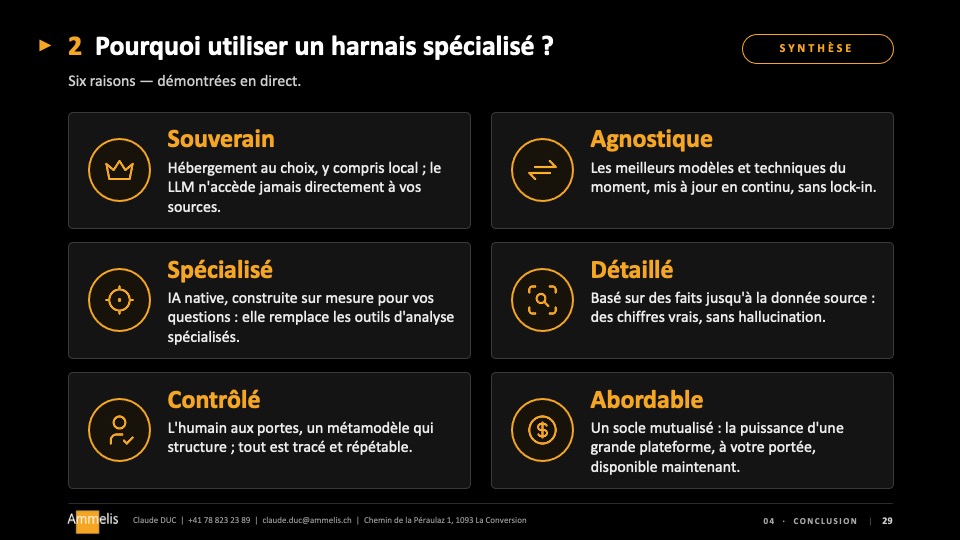 The slide’s six reasons for a specialised harness (sovereign, model-agnostic, specialised, detailed, controlled, affordable) are the case behind the takeaways below.
Provided by the author
- Stop comparing models. Ask which harness lets you swap them.
- Run repeatable analysis as execution flows, with a human at every gate.
- Keep your facts in a knowledge base you own: your system of record.
- Choose where it is hosted, and keep the model away from your raw sources.
- Start from the decision question and extract only what it needs.
- Let documentation fall out of decisions, and drop the rest.
- Measure after go-live on the same facts you used before.
A caveat: what we showed is a demo with deliberately simple scenarios on five processes. The principles carry over to your own questions, and to any enterprise-level discipline.
Read the book
 The book: Screw Architecture, Manage Change, by Dimitri Van de Putte.
Cover of the book (© Dimitri Van de Putte)
The talk was about business analysis and process optimisation. The book is about architecture and change. The thread is the same: fewer artifacts, more decisions, and the discipline to check them afterwards.
Screw Architecture Manage Change is available here:
- E-book: https://wellofwisdom.community/b/samcebook
- Paperback: https://wellofwisdom.community/b/samcpaperback
More on the book and the community: http://wellofwisdom.community
And a question to take with you: which decision in your organisation could you check against facts a year from now? Tell me in the comments.
Screw Architecture Manage Change — the CEO playbook, 40 diagrams and the deck. Ebook €24.50, paperback €44.50.
Get the bookOne mail with the chapter, then an occasional note like this one — and €5 off the book when you decide.