
Why I Wrote a Book That Isn't Really About Architecture

Since I told people I was writing a book, I've gotten the same question over and over: "So it's about architecture?"
Not really. And that's the point.
I didn't write Screw Architecture, Manage Change to talk about frameworks, reference models, or which diagramming tool you should use. I wrote it because I kept watching organizations spend more, move slower, and call it transformation — and I got tired of watching architecture take the blame for a problem it was never built to solve on its own: change.
What I actually kept seeing
For years, across very different clients and very different industries, I watched the same pattern repeat itself almost exactly.
A company launches a transformation program. New platforms, new integrations, new vendors. Everyone is optimistic. Eighteen months later, the budget is bigger, the roadmap is longer, and somehow the organization is harder to change than before it started.
Someone always looks at architecture and says: "This is the problem. We need better governance. More principles. A stronger framework."
So they add more architecture. And the next transformation is slower still.
That's not a technology problem. That's not even really an architecture problem. It's a change problem, and everyone keeps reaching for the wrong tool to fix it.
Architecture was never the goal
Here's the uncomfortable part I had to sit with while writing this: architecture, as most organizations practice it, has become a form of theater.
Review boards that approve everything because the real decision happened weeks earlier when someone picked a vendor. Diagrams that document complexity instead of removing it. Frameworks that make people feel disciplined without making the organization one bit easier to change.
None of that is malicious. It's just what happens when architecture forgets what it's for.
The goal was never architectural maturity. The goal is adaptability — the organization's ability to absorb accelerating change, market pressure, regulation, and technology shifts without collapsing under its own complexity. Architecture, done right, is the engine that makes that possible. Done wrong, it's just another layer of noise competing for attention with the noise it was supposed to cut through.
Why now, and why this was hard
I'll be honest, because the book asks everyone else to be honest, so I should start.
Writing this wasn't just a technical exercise of organizing twenty years of client work into chapters. There's an emotional side to putting your thinking out in public that nobody warns you about. You second-guess whether anyone needs another business book. You wonder if you're just adding to the noise you spend the whole book criticizing.
I found some time at the end of 2025, after a lot of "I'll write it someday," and decided someday had to become now. What's in my head after years of doing this work isn't useful sitting in my head. Sharing is caring — genuinely, that's the whole motivation. If even part of this saves one organization from mistaking documentation for progress, it was worth the discomfort of hitting publish.
What the book is actually about
So if you're waiting for a book about TOGAF variants or the perfect capability map, this isn't it. Screw Architecture, Manage Change is about:
- Why accelerating change breaks organizations that were built for stability
- Why more architecture often produces less adaptability, not more
- What it actually takes to build change capacity instead of change theater
- How a handful of disciplined decisions — reuse, standardization, saying no — compound into an organization that gets easier to change over time instead of harder
Architecture shows up throughout, because it's the discipline I know best and the lever I've seen work. But it's a supporting character. Change is the main plot.
Launching in September
The book is in its final stages now and launches in September. I'll be sharing more of the thinking behind it between now and then — the ideas, the arguments, and probably a few of the mistakes I made writing it.
If you want those updates as they happen, the best place is the book's site.
Come for the architecture talk, stay for the argument that architecture was never really the point.
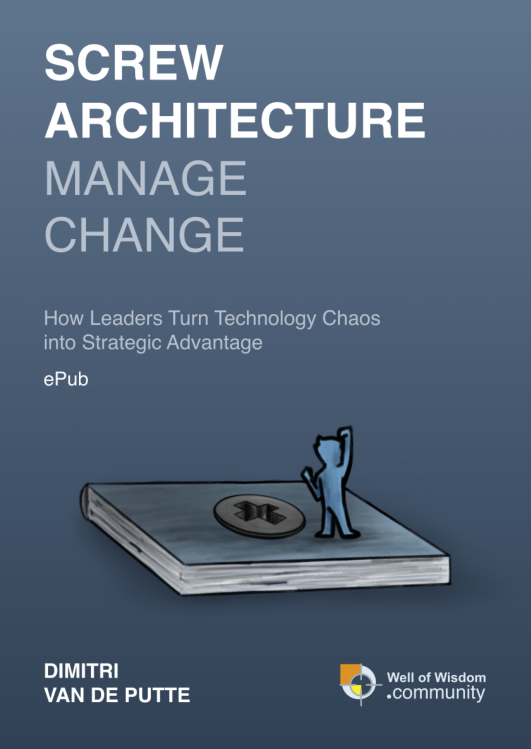
Screw Architecture Manage Change — the CEO playbook, 40 diagrams and the deck. Ebook €24.50, paperback €44.50.
Get the bookOne mail with the chapter, then an occasional note like this one — and €5 off the book when you decide.